Story
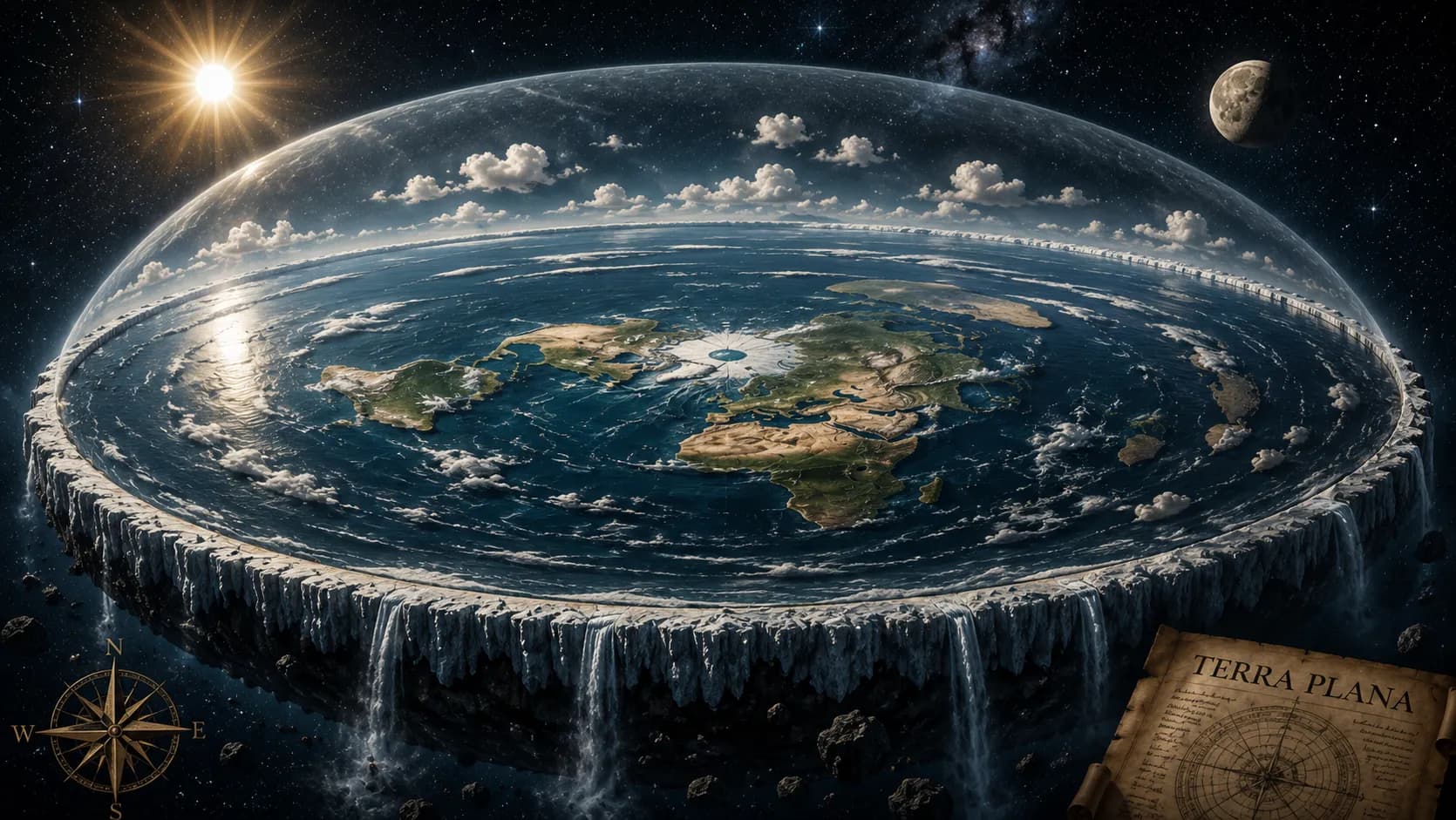
The Flat Earth theory claims that Earth is not a spherical planet but a vast flat disc.
According to its supporters, images of Earth taken from space are falsified and space agencies participate in a worldwide cover-up.
In the most common version of the theory, the North Pole lies at the center of the disc while Antarctica forms a gigantic wall of ice surrounding the world.
This barrier supposedly prevents the oceans from spilling into the void.
Supporters of this hypothesis challenge many established scientific concepts, including gravity, satellites, space travel, and certain laws of modern physics.
According to them, everyday observations such as the seemingly flat horizon and various visual experiments prove that Earth is not a sphere.
Scientists, however, explain these phenomena through the planet's immense size and the effects of perspective.
The Flat Earth theory experienced renewed popularity with the rise of the Internet and social media.
Today, despite overwhelming scientific evidence demonstrating Earth's spherical shape, the theory continues to attract followers and remains one of the world's best-known conspiracy theories.
Credits and origin
The belief in a flat Earth dates back to ancient times.
The modern version of the theory emerged during the 19th century through Samuel Rowbotham.
Scientific evidence supporting Earth's curvature is overwhelming today: space photography, astronomical observations, satellites, eclipses, geodetic measurements, and space missions.
Main inspirations:
• Modern conspiracy theories
• Distrust of institutions
• Alternative interpretations of science
• Debates about space exploration
• Social media and the Internet
• Pseudoscientific beliefs
Origin: Modern conspiracy theory
Modern popularization: 19th century and later the Internet
Notable figure: Samuel Rowbotham
Scientific position: Refuted by observations and experimental evidence