The Winchester Mystery House
By ABYSSGENERATED
Published: 2026-06-28
Updated: 2026-06-28
Discover the fascinating history of the Winchester Mystery House, famous for its bizarre architecture, ghost legends, and enduring mysteries.
The Strange Story of the Winchester Mystery House
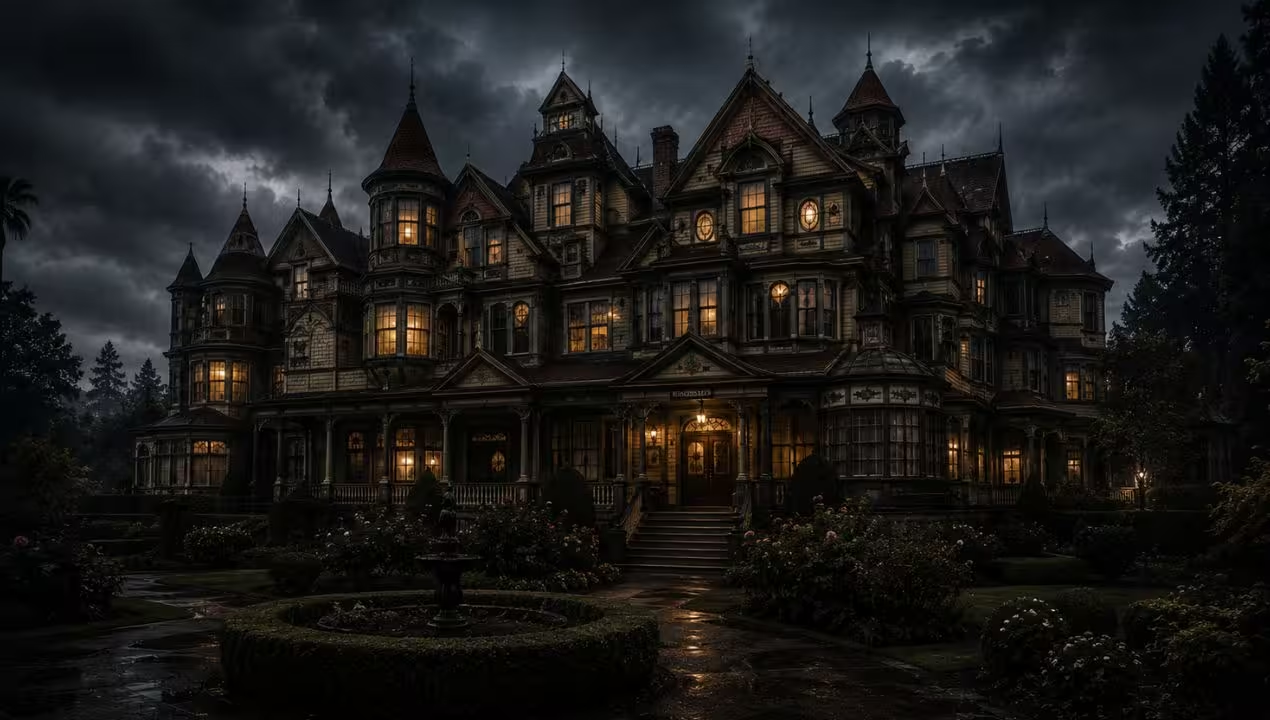
Located in San Jose, California, the Winchester Mystery House is one of the most famous and enigmatic buildings in the United States. Known for its maze-like layout, staircases leading nowhere, hidden passages, and countless legends, the mansion has fascinated historians, architects, paranormal investigators, and curious visitors for more than a century. Unlike many supposedly haunted houses whose stories rely almost entirely on folklore, the Winchester Mystery House is a real historic landmark with a well-documented past. However, over time, historical facts have become intertwined with myths and ghost stories, creating one of America's most enduring paranormal legends. Every year, hundreds of thousands of visitors walk through its winding corridors hoping to understand why Sarah Winchester devoted nearly four decades to continuously expanding her home. Some believe she was attempting to escape a supernatural curse, while others see her as an intelligent and creative woman with an extraordinary passion for architecture. Today, the mansion remains one of California's most popular historic attractions and a symbol of the enduring fascination with haunted places and unexplained mysteries.
Who Was Sarah Winchester?
Sarah Lockwood Pardee was born in New Haven, Connecticut, in 1839. Raised in a wealthy and well-educated family, she received an exceptional education at a time when advanced schooling for women was uncommon. She studied languages, literature, mathematics, science, and music, becoming known for her intelligence and refined cultural interests. In 1862, she married William Wirt Winchester, the son of Oliver Winchester, founder of the Winchester Repeating Arms Company. During the second half of the nineteenth century, the company became one of America's most successful firearms manufacturers, producing the famous Winchester repeating rifles that played a significant role in the expansion of the American West. Despite their financial success, Sarah and William experienced profound personal tragedy. Their only child, Annie Pardee Winchester, died shortly after birth from a rare childhood illness. Years later, in 1881, William Winchester died of tuberculosis at the age of forty-three. His death left Sarah emotionally devastated but also made her one of the wealthiest women in America. She inherited millions of dollars, along with a substantial share of the Winchester company, providing her with a daily income that allowed her to pursue virtually any project she desired.
A New Beginning in California
Following her husband's death, Sarah decided to leave Connecticut and start a new life on the West Coast. In 1886, she purchased a modest farmhouse in the Santa Clara Valley near San Jose, California. Rather than building an entirely new residence, she began expanding the existing property. What started as a relatively ordinary farmhouse gradually evolved into one of the most unusual private homes ever constructed. Over the following decades, additional rooms, towers, hallways, staircases, and wings were added almost continuously. Instead of following a master architectural blueprint, the mansion appears to have developed organically, with Sarah frequently changing plans as construction progressed. Historians believe she personally supervised much of the work, discussing ideas directly with craftsmen and builders while constantly redesigning sections of the house.
The Birth of a Legendary Mystery
Perhaps the best-known story surrounding the mansion is the legend of the curse. According to popular tradition, Sarah Winchester consulted a spiritual medium after the death of her husband. The medium allegedly told her that the spirits of those killed by Winchester rifles were seeking revenge against her family. To escape their wrath, she was instructed to move west and build a house that would never be finished. As long as construction continued, the spirits supposedly would not claim her life. Although this dramatic story has become inseparable from the mansion's identity, historians have found no contemporary evidence that such a séance ever took place. The tale appears to have emerged gradually during the early twentieth century as the mansion gained popularity among tourists and journalists. Nevertheless, the legend reflects an important aspect of American society during that era. Spiritualism was extremely popular in the late nineteenth century, particularly among families who had experienced loss. Many people believed that séances and mediums could provide comfort by allowing communication with deceased loved ones. Whether Sarah Winchester truly embraced these beliefs remains uncertain, but the popularity of Spiritualism undoubtedly helped shape the myths that continue to surround her today.
History and Folklore Intertwined
More than a century after Sarah Winchester's death, historians continue to distinguish carefully between documented facts and popular legend. Historical records clearly confirm Sarah's immense fortune, the decades-long construction of the mansion, and its extraordinary architecture. The stories of ghosts, curses, and supernatural guidance, however, remain part of American folklore rather than established history. It is precisely this unique combination of reality and legend that makes the Winchester Mystery House so compelling. Every verified historical detail seems to generate new questions, while every unexplained architectural feature encourages fresh speculation. Whether viewed as an architectural masterpiece, an expression of personal grief, or one of America's greatest paranormal mysteries, the Winchester Mystery House continues to inspire curiosity and debate around the world.
Nearly Four Decades of Continuous Construction
Construction on the Winchester estate began shortly after Sarah Winchester purchased the property in 1886. Contrary to popular legend, builders did not necessarily work every hour of every day, but renovations and expansions continued almost constantly for nearly thirty-eight years, ending only with Sarah's death in 1922. Teams of carpenters, masons, blacksmiths, plumbers, and skilled craftsmen regularly worked on the property. Unlike most large homes of the era, the mansion never followed a single master plan. Instead, rooms were added, hallways extended, towers constructed, and entire sections remodeled whenever Sarah decided changes were needed. This unusual approach resulted in a house that appears to have grown organically over several decades rather than being designed as a single architectural project. Every addition changed the layout of the building, creating the maze-like structure visitors see today. Before the devastating 1906 San Francisco earthquake, some historians believe the mansion may have reached seven stories in height. Following the earthquake, several damaged sections were removed or permanently sealed, dramatically changing the appearance of the estate.
A One-of-a-Kind Architectural Wonder
Today, the Winchester Mystery House contains more than 160 rooms, dozens of staircases, numerous fireplaces, hidden passages, and an astonishing collection of architectural curiosities. Among its most famous features are staircases that end at ceilings, doors opening into walls or empty space, windows overlooking interior rooms, and hallways that appear to lead nowhere. These unusual elements have become defining characteristics of the mansion and have inspired countless ghost stories. However, architectural historians point out that many of these oddities have practical explanations. Because the mansion was constantly remodeled, older rooms were frequently incorporated into new additions. Doorways that once connected two rooms sometimes became blocked by later construction, while windows originally facing outdoors eventually overlooked newly built interior spaces. The mansion is also filled with secret passageways that allowed servants to move discreetly throughout the house without disturbing guests. Some hidden spaces were designed for storage, while others provided convenient access for maintenance. Rather than representing supernatural design, many of these features demonstrate how decades of continuous expansion gradually transformed a conventional farmhouse into one of the world's most unusual residences.
Remarkable Innovation for Its Time
Although famous for its mysteries, the Winchester Mystery House was also remarkably advanced from an engineering perspective. The mansion included indoor plumbing, multiple bathrooms with hot running water, gas and electric lighting during a period of technological transition, sophisticated heating systems, elevators, and an extensive network of servant call bells. These features were considered luxurious at the end of the nineteenth century and reflected Sarah Winchester's willingness to invest in modern technology. The house also showcases extraordinary craftsmanship. Beautiful hardwood floors, hand-carved woodwork, decorative ceilings, and elegant stained-glass windows demonstrate the exceptional skills of the artisans who worked on the property. Several stained-glass windows were produced by the renowned Tiffany Studios. Interestingly, some of these artistic masterpieces were installed in locations where sunlight could never reach them, adding yet another layer of mystery to the mansion's design.
The Mystery of the Number Thirteen
Visitors quickly notice another recurring feature throughout the house: the frequent appearance of the number thirteen. Many windows contain thirteen glass panels. Chandeliers often feature thirteen lights. Some staircases consist of exactly thirteen steps, while decorative elements throughout the mansion repeat the same number. This unusual pattern has generated countless theories. Some paranormal enthusiasts believe Sarah Winchester considered thirteen a mystical or protective number. Others argue that it may have reflected personal preferences or aesthetic choices rather than superstition. No historical documents written by Sarah herself explain the repeated use of the number, leaving the question unanswered.
The 1906 San Francisco Earthquake
On April 18, 1906, one of the most destructive earthquakes in American history struck Northern California. The earthquake, estimated at magnitude 7.9, devastated San Francisco and caused severe damage throughout the region. The Winchester Mansion suffered extensive structural damage. Towers collapsed, chimneys fell, and entire sections of the building became unstable. According to several accounts, Sarah Winchester herself became temporarily trapped inside one room until servants managed to free her. Rather than restoring every damaged section, she chose to seal off or demolish several portions of the mansion. Some rooms remain inaccessible even today, preserving a unique glimpse into the building's history. The earthquake also explains many of the mansion's architectural oddities. Staircases that once connected upper floors suddenly ended at ceilings after damaged levels were removed. Windows that originally faced outside became interior windows following later reconstruction. These practical changes contributed significantly to the mysterious appearance that visitors associate with the Winchester Mystery House today.
A Living Architectural Puzzle
Architects and preservation specialists often regard the Winchester Mystery House as one of the most unusual examples of evolving residential architecture ever created. Rather than following a rigid blueprint, the building developed through decades of experimentation, renovation, and adaptation. Every corridor, staircase, and hidden room tells part of the story of a house that was never truly finished. More than one hundred years after construction ended, the mansion remains a remarkable blend of engineering, craftsmanship, creativity, and mystery. Whether admired for its architectural innovation or its legendary reputation, it continues to stand as one of America's most extraordinary historic homes.
Ghost Stories and Paranormal Claims
For decades, the Winchester Mystery House has been regarded as one of the most famous allegedly haunted locations in the United States. Visitors, tour guides, employees, and paranormal enthusiasts have shared countless stories describing unusual experiences inside the mansion. Some report hearing unexplained footsteps echoing through empty hallways, while others claim to have heard whispers, doors closing on their own, or mysterious knocking sounds with no obvious source. Several visitors have described sudden drops in temperature, strange scents, or an overwhelming feeling of being watched despite being alone. Among the mansion's most enduring legends is the alleged appearance of a man wearing work clothes and carrying construction tools. According to numerous accounts, this mysterious figure is occasionally seen repairing fireplaces or walking through unfinished sections of the house before suddenly disappearing. Many believe he represents one of the craftsmen who worked on the mansion during Sarah Winchester's lifetime. Other witnesses claim to have seen a woman dressed in black quietly walking through the corridors or standing near one of the mansion's many windows. While some speculate that this figure could be Sarah Winchester herself, no evidence has ever confirmed such claims. Although these stories cannot be scientifically verified, they continue to shape the mansion's reputation as one of America's best-known haunted houses.
Paranormal Investigations
The Winchester Mystery House has attracted paranormal investigators from around the world. Television crews, ghost hunting organizations, researchers, and independent investigators have conducted numerous overnight investigations within the mansion. Modern investigations often involve infrared cameras, thermal imaging devices, digital voice recorders, electromagnetic field detectors, motion sensors, and environmental monitoring equipment. Investigators hope to capture evidence of unexplained activity while carefully documenting natural conditions inside the building. Some teams claim to have recorded Electronic Voice Phenomena (EVPs), faint voices or sounds that appear on digital recordings despite not being heard during the investigation itself. Others have reported unexplained shadows, mysterious light anomalies, or unusual fluctuations in electromagnetic readings. However, scientists and skeptical investigators point out that many of these observations have ordinary explanations. Electrical equipment, camera reflections, dust particles, insects, changing humidity, and the mansion's aging structure can all produce effects that appear mysterious without necessarily indicating paranormal activity. To date, no investigation has produced evidence that has been universally accepted by the scientific community as proof of ghosts or supernatural phenomena.
What Historians Believe
Professional historians generally offer a much more practical interpretation of the Winchester Mystery House. Rather than focusing on ghost stories, they emphasize Sarah Winchester's wealth, independence, and lifelong interest in architecture. Following the deaths of her husband and daughter, the mansion became both her residence and her personal creative project. Because she possessed virtually unlimited financial resources, Sarah could continuously redesign the property without the financial limitations that most homeowners faced. She frequently instructed builders to modify existing rooms, expand hallways, relocate staircases, or construct entirely new sections whenever she wished. Many architectural oddities therefore reflect decades of renovations rather than supernatural intentions. Historians also note that the devastating 1906 earthquake significantly altered the building. Entire floors disappeared, walls were rebuilt, and damaged rooms were permanently sealed. These practical changes explain many features that later became associated with paranormal legends.
Why the Legend Endures
The Winchester Mystery House occupies a unique place in American culture because it combines documented history with enduring mystery. Unlike fictional haunted houses, the mansion truly exists. Visitors can walk through its corridors, examine its unusual architecture, and experience firsthand the environment that inspired generations of ghost stories. Its remarkable design naturally encourages curiosity. Every staircase that ends at a ceiling or door that opens into empty space invites visitors to imagine hidden meanings and forgotten secrets. Human psychology also plays an important role. When people visit a location already famous for paranormal activity, they are often more attentive to unfamiliar sounds, unusual lighting conditions, or unexpected sensations. This expectation can influence how ordinary experiences are interpreted. As a result, every visitor leaves with a different impression. Some see a masterpiece of Victorian architecture, while others remain convinced that unexplained forces still inhabit the mansion.
The Winchester Mystery House in Popular Culture
The mansion has become one of the most recognizable haunted locations in popular culture. It has appeared in countless documentaries exploring ghosts, haunted places, and unexplained mysteries. Television series dedicated to paranormal investigations—including Ghost Adventures, Ghost Hunters, and several international productions—have all featured the mansion in episodes examining its mysterious reputation. Books about American folklore, haunted houses, and unexplained history frequently include the Winchester Mystery House as one of the country's most famous paranormal locations. The mansion has also inspired novels, comics, podcasts, escape rooms, and video games that borrow elements of its maze-like architecture and ghostly legends. In 2018, the feature film Winchester, starring Academy Award-winning actress Helen Mirren as Sarah Winchester, introduced the story to an international audience. While the movie takes significant creative liberties and emphasizes supernatural horror, it renewed public interest in the mansion and encouraged many people to explore its true history. Today, the Winchester Mystery House remains one of the world's most recognizable symbols of haunted architecture, where documented history and enduring legend continue to exist side by side.
The Winchester Mystery House Today
When Sarah Winchester died on September 5, 1922, construction on the mansion came to an immediate end. Workers reportedly stopped what they were doing almost instantly, leaving behind tools, unfinished projects, and rooms that would never be completed. In the years that followed, the estate was sold and eventually transformed into a public attraction. Since opening to visitors in 1923, the Winchester Mystery House has become one of California's most visited historic landmarks, welcoming hundreds of thousands of guests every year. Guided tours allow visitors to explore many of the mansion's remarkable rooms while learning about Sarah Winchester's life, the building's extraordinary architecture, and the legends that continue to surround it. Although much of the house is accessible, certain sections remain closed either for preservation purposes or because they are still undergoing restoration. Far from being simply a haunted attraction, the mansion has become an important part of California's architectural and cultural heritage.
Preserving a Historic Landmark
Maintaining a structure as large and complex as the Winchester Mystery House is a constant challenge. Specialists in historic preservation work throughout the year to restore woodwork, stained-glass windows, decorative ceilings, fireplaces, and countless original architectural details. Because much of the mansion was built using nineteenth-century construction techniques, repairs often require traditional craftsmanship and historically accurate materials. Researchers also continue studying original photographs, financial records, and surviving documents to better understand how the mansion evolved over nearly four decades of construction. Every restoration project helps preserve one of America's most unusual historic homes while providing new insights into Sarah Winchester's remarkable architectural vision.
Seasonal Events and Night Tours
In addition to its traditional guided tours, the Winchester Mystery House hosts numerous special events throughout the year. Halloween is by far the busiest season. During October, the mansion offers themed evening tours, immersive experiences, and seasonal attractions inspired by its famous ghost stories. These events attract visitors from across the United States and have become an annual tradition for many paranormal enthusiasts. The mansion also organizes educational tours focusing on Victorian architecture, California history, craftsmanship, and historic preservation. These programs emphasize the building's historical significance rather than its supernatural reputation. By combining education with storytelling, the Winchester Mystery House successfully appeals to both history enthusiasts and fans of unexplained mysteries.
Separating Fact from Fiction
One of the greatest challenges surrounding the Winchester Mystery House is distinguishing historical fact from popular legend. Historical records clearly document Sarah Winchester's ownership of the property, the decades of continuous construction, and the mansion's unusual architectural evolution. These facts are supported by photographs, financial records, newspaper articles, and surviving correspondence. By contrast, many of the mansion's most famous ghost stories appeared years after Sarah's death. Tales of curses, restless spirits, and supernatural instructions from a medium are largely based on oral tradition rather than contemporary historical evidence. This does not necessarily diminish the mansion's fascination. Instead, it demonstrates how powerful storytelling can transform a remarkable historical building into a worldwide cultural icon.
Why the Mansion Continues to Fascinate
More than one hundred years after Sarah Winchester's death, public interest in the mansion shows no signs of fading. Its enduring popularity stems from a unique combination of factors: an extraordinary life story, one of the most unusual houses ever built, mysterious architectural features, and legends that continue to evolve with every generation. For historians, the mansion represents a fascinating example of Victorian architecture and personal creativity. For architects, it is an unparalleled case study in continuous expansion without a master plan. For paranormal enthusiasts, it remains one of America's most intriguing haunted locations. Few places manage to appeal simultaneously to historians, engineers, ghost hunters, architects, filmmakers, and curious tourists.
Legacy in Popular Culture
The Winchester Mystery House has become deeply embedded in American popular culture. It regularly appears in books, documentaries, podcasts, magazine articles, television series, and online videos exploring haunted places and unexplained phenomena. It has inspired horror films, novels, escape rooms, board games, and video games, ensuring that its legend reaches new audiences every generation. Social media has further expanded its global reputation. Millions of people discover the mansion each year through YouTube videos, TikTok creators, travel blogs, and paranormal documentaries, making it one of the most recognizable haunted landmarks in the world. Its influence extends far beyond California, becoming part of the broader fascination with mysterious places, ghost stories, and unexplained history.
Conclusion
Whether viewed as an architectural masterpiece, a historical curiosity, or one of America's greatest paranormal legends, the Winchester Mystery House remains unlike any other building in the world. Its story combines genuine historical events with myths that have grown over more than a century. Sarah Winchester's remarkable life, the mansion's extraordinary design, and the countless legends surrounding the property continue to inspire debate, investigation, and imagination. Although historians generally reject the idea of a supernatural curse, the absence of definitive answers has only strengthened the mansion's appeal. Visitors continue to leave with their own interpretations, ensuring that the legend remains alive. More than a hundred years after construction ended, the Winchester Mystery House stands as a timeless symbol of mystery, creativity, and the enduring human fascination with the unknown. Whether you are interested in history, architecture, folklore, or paranormal phenomena, it remains one of the most captivating destinations in the United States.
Credits and origin
Origin of the Legend
The Winchester Mystery House is one of the most iconic locations in American paranormal folklore. Its reputation developed throughout the twentieth century, blending documented historical facts with eyewitness accounts, local legends, and popular ghost stories. While the mansion's extraordinary architecture is well documented, the tales of ghosts, curses, and supernatural events remain rooted primarily in folklore rather than verified historical evidence.
Sarah Lockwood Winchester, widow of William Wirt Winchester and heiress to the Winchester Repeating Arms Company fortune, became the central figure of the legend. Her private lifestyle, the decades-long construction of her unusual home, and the lack of clear historical explanations for many of her architectural decisions have fueled speculation for more than a century. Today, the Winchester Mystery House stands as one of America's best-known mystery landmarks, where history, architecture, and paranormal folklore continue to captivate millions of visitors.
Main Inspirations
- Sarah Lockwood Winchester
- Winchester Repeating Arms Company
- Nineteenth-century American Spiritualism
- Late Victorian (Queen Anne) architecture
- American haunted house legends
- Modern paranormal investigations
- Visitor and employee testimonies
- Books, documentaries, and television programs about the paranormal
Key Facts
- Official Name: Winchester Mystery House
- Location: San Jose, California, USA
- Construction Period: 1886–1922
- Architect: No principal architect (continuous construction directed by Sarah Winchester)
- Historic Owner: Sarah Lockwood Winchester
- Architectural Style: Queen Anne Victorian with numerous additions
- Approximate Number of Rooms: More than 160
- Type: Historic mansion and paranormal legend
- Current Status: Historic landmark and major tourist attraction
- Notable Features: Staircases leading nowhere, doors opening into empty space, hidden passages, Tiffany stained-glass windows, and maze-like architecture
- Popularized Through: Books, documentaries, feature films, video games, podcasts, and paranormal television series
FAQ
Why is the Winchester Mystery House considered haunted?
Its reputation comes from the legends surrounding Sarah Winchester, numerous visitor reports of strange occurrences, and its unusual architecture. However, no scientific evidence has confirmed paranormal activity.
Who was Sarah Winchester?
Sarah Winchester was the widow of William Wirt Winchester, heir to the Winchester Repeating Arms Company. She lived in the mansion for nearly forty years and oversaw its continuous expansion.
Why does the house have staircases and doors that lead nowhere?
These unusual features resulted from decades of constant renovations and additions. They have also helped fuel the many legends surrounding the mansion.
How many rooms are in the Winchester Mystery House?
The mansion contains more than 160 rooms, along with dozens of staircases, fireplaces, windows, and doors, making it one of the most complex houses ever built.
Can you visit the Winchester Mystery House today?
Yes. Located in San Jose, California, the Winchester Mystery House is open to the public and offers guided tours exploring its history, architecture, and enduring legends.
Is the Winchester Mystery House really haunted?
There is no scientific evidence proving that the mansion is haunted. Reports of paranormal activity are based primarily on eyewitness accounts, investigations, and local folklore.