The Dyatlov Pass Incident
By ABYSSGENERATED
Published: 2026-07-04
Updated: 2026-07-04
In February 1959, nine experienced Soviet hikers disappeared in the Ural Mountains. Their abandoned campsite and mysterious deaths gave rise to one of modern history's greatest unsolved mysteries.
The Dyatlov Pass Incident: One of the Greatest Mysteries of the Twentieth Century
Few historical events have generated as much fascination as the Dyatlov Pass Incident. More than six decades after the tragedy, the mysterious deaths of nine experienced Soviet hikers continue to inspire scientific research, documentaries, books, and countless theories. What initially appeared to be a tragic mountaineering accident gradually became one of the world's most enduring historical mysteries, largely because many of the facts surrounding the expedition remain difficult to explain with absolute certainty. During the night of February 1–2, 1959, nine young hikers lost their lives on the snowy slopes of Kholat Syakhl, a remote mountain in the northern Ural Mountains of the former Soviet Union. When rescue teams eventually reached the campsite several weeks later, they found a deeply unsettling scene. The expedition's tent had been cut open from the inside, most of the group's winter clothing and equipment had been left behind, and footprints showed that the hikers had calmly walked away from their shelter despite temperatures falling below -30°C (-22°F). The first bodies were discovered hundreds of meters from the campsite, some wearing only light clothing despite the freezing conditions. Months later, the remaining victims were found beneath several meters of snow inside a nearby ravine. While some hikers had clearly died from hypothermia, others displayed severe internal injuries that puzzled both investigators and forensic experts. This unusual combination of established facts and unanswered questions is one of the main reasons why the Dyatlov Pass Incident continues to fascinate historians, scientists, and mystery enthusiasts around the world.
Where Is Dyatlov Pass?
Dyatlov Pass is located in the northern Ural Mountains within Russia's Sverdlovsk Oblast. Even today, the region remains one of the most remote and sparsely populated areas of the country. During winter, temperatures frequently fall below -30°C, while powerful winds sweep across the exposed mountain slopes, creating extremely dangerous conditions for anyone traveling through the area. The tragedy took place on the eastern slope of Kholat Syakhl, a mountain standing just over 1,000 meters above sea level. Its name is commonly translated from the Mansi language as "Dead Mountain." This dramatic name has often fueled speculation about supernatural legends surrounding the site. Historians, however, point out that the name is simply a traditional geographical designation and does not refer to an ancient curse or mysterious event. The location became known as "Dyatlov Pass" only after the tragedy. In memory of the expedition leader, Soviet authorities officially named the mountain pass after Igor Dyatlov.
An Expedition of Experienced Hikers
Contrary to many popular misconceptions, the members of the Dyatlov expedition were not inexperienced adventurers. Every participant was either a student or a graduate of the Ural Polytechnic Institute and had already completed numerous demanding hiking expeditions. Several had extensive experience with winter mountaineering and were highly skilled in navigation, skiing, camp construction, and cold-weather survival. The purpose of the expedition was to complete a route qualifying for Category III certification, the highest level of hiking achievement recognized by Soviet sporting authorities at the time. Successfully finishing such an expedition required excellent physical condition, technical knowledge, and the ability to survive for many days in one of the harshest winter environments on Earth. The expedition was led by twenty-three-year-old Igor Alekseyevich Dyatlov, an engineering student known among his classmates for his discipline, organizational skills, and extensive experience in the mountains. His teammates trusted his judgment completely, making him the natural leader of the group. The remaining members of the expedition were equally capable. Zinaida Kolmogorova was admired for her remarkable endurance, while Lyudmila Dubinina had already participated in several challenging winter expeditions despite her young age. Semyon Zolotaryov, the oldest member of the group, brought valuable experience gained during the Second World War. Together, the nine hikers formed a well-prepared and highly motivated team that appeared fully capable of completing the demanding journey ahead. Nothing suggested that this carefully planned sporting expedition would soon become one of the greatest historical mysteries of the twentieth century.
The Beginning of the Journey
The expedition officially began on January 23, 1959, when the group departed from Sverdlovsk, now known as Yekaterinburg. Their journey initially continued by train before they transferred to trucks that carried them toward the last inhabited settlements in the northern Ural region. Throughout the trip, the hikers kept detailed journals, photographed their surroundings, and documented each stage of their adventure. The surviving photographs reveal a group in excellent spirits. The students can be seen laughing, posing for the camera, preparing equipment, and enjoying the excitement of the expedition. These images, later recovered during the investigation, would become the final visual record of their lives before the tragedy. Their ultimate destination was Mount Otorten, a remote peak that required crossing dozens of kilometers of uninhabited wilderness. Beyond the final village, there would be no roads, no permanent settlements, and virtually no possibility of outside assistance. From that point onward, the expedition would rely entirely on its own experience, preparation, and equipment. Before entering the mountains, the hikers stopped in the small settlement of Vizhay, considered the last inhabited location before the vast wilderness of the northern Urals. Here they completed their final preparations, checked their supplies, and spoke with local residents before continuing toward the mountains. None of them could have imagined that these would be the last conversations they would ever have with the outside world.
The Only Survivor
On January 28, 1959, the composition of the expedition changed unexpectedly. One of the ten participants, Yuri Yudin, began suffering severe pain caused by a chronic back condition and joint disease that had troubled him for several years. As the group advanced deeper into the mountains, his condition worsened to the point where continuing the journey became impossible. After discussing the situation with Igor Dyatlov, Yudin made the difficult decision to turn back. His companions helped him prepare for the return journey before continuing toward Mount Otorten. Although the decision was made solely for medical reasons, it ultimately saved his life. Yuri Yudin became the only member of the expedition to survive. For the rest of his life, Yudin spoke openly about the guilt he felt after leaving his friends behind. He remained closely involved with research into the incident, attended commemorative events, and hoped that one day the full truth about the tragedy would finally be uncovered.
The Expedition Continues
After Yuri Yudin's departure, the remaining nine hikers continued their journey without any major difficulties. Their journals indicate that the expedition was progressing largely according to plan. Each day was carefully documented through written notes and photographs, providing modern historians with a remarkably detailed record of the trip before the disaster occurred. The hikers described a landscape that was both breathtaking and unforgiving. Dense forests gradually gave way to wide, snow-covered valleys where powerful winds swept across the open terrain. Although temperatures remained well below freezing, nothing in their journals suggests that the group believed they were facing exceptional danger. As experienced mountaineers, they adjusted their pace to match the weather conditions and established camp before nightfall whenever possible. The photographs taken during this period show ordinary scenes from a winter expedition. Some members are seen pulling sleds loaded with equipment, while others prepare meals, repair skis, or pose jokingly for the camera. These images reveal a close-knit group enjoying both the challenge and the beauty of the wilderness. Looking back today, they provide a poignant reminder that nothing appeared unusual in the days leading up to the tragedy.
Weather Conditions Begin to Deteriorate
As the expedition climbed higher into the Ural Mountains, weather conditions gradually became more severe. Strong winds reduced visibility, fresh snow covered the landscape, and the temperature continued to fall. On the exposed mountain slopes, there was little natural shelter from the harsh Arctic air moving across the region. On January 31, the group reached a wooded valley at the foot of Kholat Syakhl. There, they established a supply cache containing food and equipment that they planned to retrieve on their return journey. This was a common practice during long-distance winter expeditions, allowing hikers to reduce the weight of their packs before attempting more difficult sections of the route. The following morning, the expedition resumed its climb toward Mount Otorten. Modern researchers believe that worsening weather may have caused the group to drift slightly west of their intended route. Faced with poor visibility and increasing winds, they eventually decided to establish camp on the open slope of Kholat Syakhl rather than descend into the shelter of the nearby forest. Although this decision has often been criticized in hindsight, it was consistent with mountaineering techniques commonly used by experienced Soviet hikers at the time. Camping on the slope allowed the group to maintain altitude and continue their journey more efficiently the next morning without having to climb back out of the valley.
The Final Camp
Late in the afternoon of February 1, 1959, the hikers began constructing their camp on the mountainside. To create a level surface, they carefully cut into the snowpack before securing their large expedition tent with skis, poles, and ropes. According to the recovered photographs, the work progressed normally despite the worsening weather. The final images taken by the expedition show the group carrying equipment through deep snow, erecting the tent, and working together as they had done throughout the journey. Several photographs even capture moments of laughter despite the freezing temperatures and strong winds. Nothing in the available evidence suggests that the hikers felt threatened or anticipated any immediate danger. Their journals contain no mention of unusual sounds, strange lights, wildlife encounters, or conflicts within the group. The atmosphere appears calm, professional, and entirely consistent with a routine evening during a demanding winter expedition. As darkness settled over the mountains, the nine hikers climbed into their sleeping bags expecting nothing more than another cold night before continuing toward their destination the following morning. Instead, sometime during the night, an unknown event forced every member of the expedition to abandon the safety of their tent. Within only a few hours, all nine would be dead, leaving behind one of the greatest unsolved mysteries in modern history.
The Search Operation
The expedition was expected to return around February 12, 1959. At first, no one became particularly concerned when the group failed to arrive on schedule. Delays were common during winter expeditions in the Ural Mountains, and Igor Dyatlov had informed his relatives that the journey could take longer than planned if weather conditions deteriorated.
As the days passed without any message, however, concern quickly grew. Family members and fellow students contacted the Ural Polytechnic Institute, urging the authorities to organize a search. On February 20, an official rescue operation was launched. Volunteer students were the first to head into the mountains, soon joined by experienced mountaineers, military personnel, local Mansi guides, and search-and-rescue teams.
The operation proved extremely challenging. Heavy snowfall, freezing temperatures, and strong winds made progress painfully slow. Aircraft searched from above whenever weather conditions allowed, while teams on skis systematically combed the mountain slopes in the hope of finding signs of the missing hikers.
The Discovery of the Tent
On February 26, rescuers finally located the expedition's campsite on the eastern slope of Kholat Syakhl. What they found immediately raised more questions than answers.
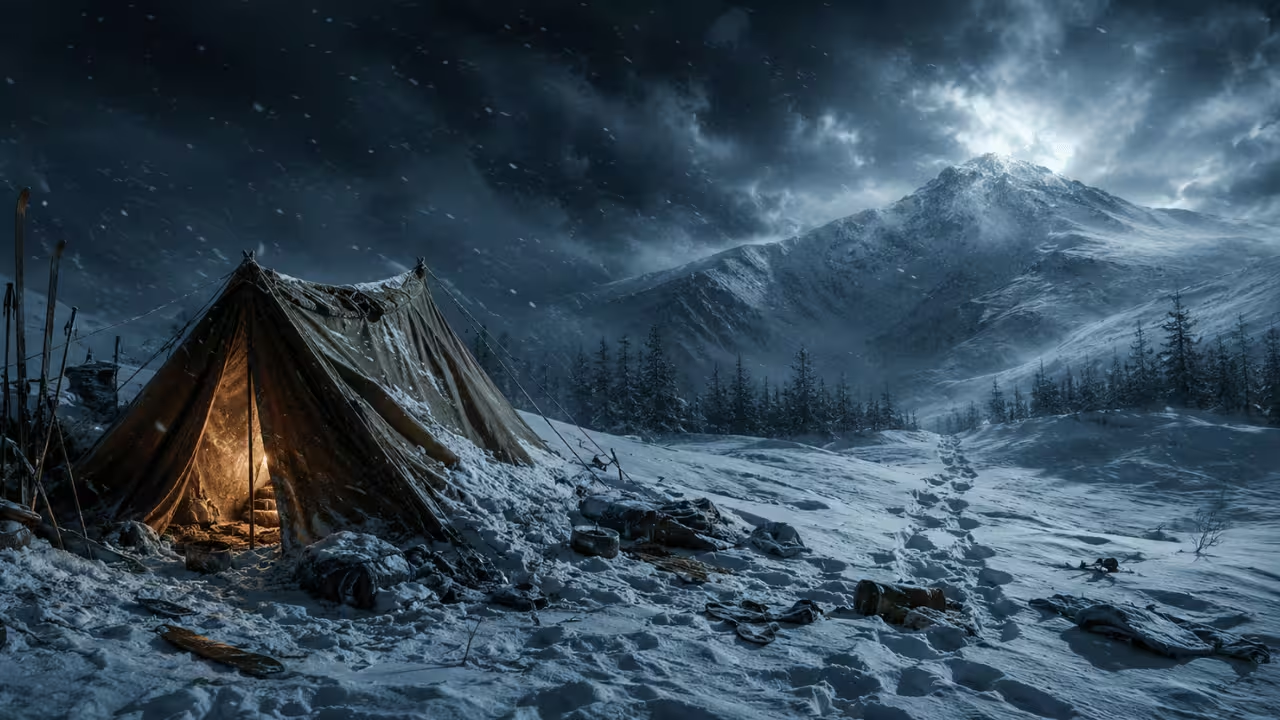
The tent was still partially standing, although it had been partially buried by drifting snow. At first glance, nothing suggested that it had been destroyed by a massive avalanche or violent explosion. However, a closer inspection revealed several long cuts in the fabric. Investigators later concluded that most of these openings had been made from inside the tent, indicating that the hikers themselves had slashed their only shelter in order to escape.
Inside the tent, nearly all of the expedition's essential equipment remained exactly where it had been left. Sleeping bags, winter boots, heavy coats, backpacks, cameras, food supplies, maps, and personal belongings were still present. The scene suggested that the group had abandoned the campsite suddenly, without taking the time to collect even the most basic items needed to survive the freezing night.
For experienced mountaineers accustomed to harsh winter conditions, such behavior appeared almost unimaginable. Whatever had forced them out of the tent must have seemed more dangerous than facing the deadly cold outside.
Footprints Leading into the Darkness
Outside the campsite, rescuers made another remarkable discovery. A series of footprints extended away from the tent, leading downhill toward a forest approximately 1.5 kilometers away.
The tracks provided valuable insight into the hikers' final movements. Rather than indicating a chaotic escape, the footprints suggested a relatively orderly retreat. Some prints belonged to people wearing boots, while others had been left by individuals wearing only socks or walking barefoot across the snow.
Equally surprising was the absence of evidence suggesting a struggle. There were no unidentified footprints surrounding the campsite, no signs that the group had been chased, and no indications of an attack by either humans or animals.
Investigators concluded that all nine hikers had likely left the tent together and followed approximately the same route toward the shelter of the forest. Why they chose to do so remains one of the central questions of the entire case.
The Cedar Tree
Following the footprints, rescuers eventually reached the edge of the forest, where they discovered a large Siberian cedar. Beneath the tree lay the first two victims: Georgiy Krivonishchenko and Yuri Doroshenko. Both men were dressed only in their underwear despite the extreme cold. Their bodies showed clear signs of severe hypothermia, and nearby investigators found the remains of a small campfire. Charred branches and ashes indicated that the hikers had successfully lit a fire in an attempt to keep warm after abandoning the tent. The cedar itself provided another intriguing clue. Numerous branches had been broken several meters above the ground, suggesting that at least one of the two men had climbed the tree. Researchers have proposed several explanations for this action. They may have been trying to look back toward the tent, searching for signs that it was safe to return. Others believe they climbed the tree to break branches for firewood or to gain a better view of the surrounding landscape. Although the exact reason remains uncertain, the damaged branches clearly demonstrate that at least some members of the expedition remained physically active for a period of time after leaving the campsite.
A Desperate Attempt to Return
As rescuers continued searching between the cedar tree and the abandoned tent, they discovered three more bodies. Igor Dyatlov, Zinaida Kolmogorova, and Rustem Slobodin were found at different points along the slope, all facing uphill toward the campsite. Their positions strongly suggest that they had attempted to return to the tent after reaching the forest. Faced with freezing temperatures and inadequate clothing, recovering their equipment would have represented their only realistic chance of survival. Igor Dyatlov's body was found lying on his back with one hand clutching a small tree branch, as though he had struggled until his final moments. Zinaida Kolmogorova was discovered farther uphill, while Rustem Slobodin had managed to travel even closer to the tent before collapsing. The sequence of these discoveries paints a tragic picture. After realizing that remaining in the forest offered little hope of survival, several members of the group appear to have made a desperate attempt to retrieve the warm clothing and supplies they had left behind. None of them succeeded. The autopsies later concluded that these first five victims had died primarily from hypothermia. However, Rustem Slobodin also suffered a skull fracture. Although forensic experts determined that this injury was not immediately fatal, it introduced another puzzling element into an already extraordinary case.
Four Hikers Still Missing
By the end of February, only five members of the expedition had been located. Four others remained missing despite extensive searches across the surrounding mountains. As winter continued, deep snow made further exploration nearly impossible. Search teams were forced to suspend operations repeatedly because of severe weather and dangerous terrain. It would not be until spring, when melting snow began exposing previously inaccessible areas, that investigators would finally discover the remaining four hikers. Those final discoveries would transform the entire investigation. The injuries found on the last victims were unlike anything observed among the first five bodies and would become the source of many of the mystery's most enduring questions.
The Discovery of the Last Four Hikers
Despite weeks of intensive searching, four members of the expedition remained missing long after the first five bodies had been recovered. The severe winter conditions made the search extremely difficult. In many places, several meters of compacted snow completely concealed the landscape, preventing rescuers from exploring ravines and other natural depressions. It was not until early May 1959, when the spring thaw began to melt the snowpack, that search teams made another significant discovery. Approximately seventy-five meters from the large cedar tree, rescuers found pieces of clothing protruding from a snow-covered ravine. After carefully removing layers of snow and ice, they recovered the bodies of Lyudmila Dubinina, Alexander Kolevatov, Semyon Zolotaryov, and Nikolai Thibeaux-Brignolle. Unlike the first five victims, these hikers were not lying on the open mountainside. They had come to rest in a deep ravine that had gradually filled with snow throughout the winter. Investigators immediately noticed that the group appeared to have attempted to build a temporary shelter. Branches had been cut, snow had been shaped into a protective area, and several items of clothing had been removed from the bodies of the first victims and reused by the remaining survivors. These discoveries revealed that the hikers had not simply wandered aimlessly after leaving their tent. Instead, they had continued making rational survival decisions despite the extreme conditions surrounding them. They gathered firewood, shared clothing, and searched for a location that offered better protection from the relentless wind. Their actions demonstrated determination and cooperation even as their chances of survival steadily diminished.
Severe Internal Injuries
The autopsies performed on the final four victims revealed injuries that immediately attracted the attention of investigators. Semyon Zolotaryov had suffered multiple fractured ribs, while Lyudmila Dubinina displayed extensive damage to her chest. Nikolai Thibeaux-Brignolle had sustained a significant skull fracture that suggested an extremely powerful impact. What made these injuries particularly unusual was the lack of corresponding external trauma. Although the internal damage was severe, the victims showed relatively little external bleeding or obvious signs of violent assault. The forensic pathologist responsible for the investigation concluded that the injuries had been caused by an enormous force acting across a broad area of the body rather than by repeated blows from a weapon. At the time, these findings puzzled investigators and fueled decades of speculation. Some authors suggested that the hikers had been struck by an explosion or subjected to a powerful blast wave. Others believed they had fallen from a great height or had been crushed beneath heavy snow. Modern biomechanical studies have demonstrated that compacted snow moving under tremendous pressure can produce injuries remarkably similar to those described in the original autopsy reports. While this does not prove exactly what happened, it offers a scientifically plausible explanation that was not fully understood in 1959.
The Case of Lyudmila Dubinina
Among all the victims, Lyudmila Dubinina has become the most discussed. During the autopsy, investigators noted that her tongue was missing, along with portions of the soft tissue from her mouth, lips, and eyes. These observations quickly became one of the most controversial aspects of the entire case. Over the decades, numerous books and documentaries claimed that her tongue had been violently removed, implying that the hikers may have been attacked or tortured before their deaths. Such interpretations contributed significantly to the mystery surrounding the incident. However, forensic experts have offered a far more ordinary explanation. Dubinina's body had remained submerged beneath snow and flowing water inside the ravine for several months before it was discovered. Under these conditions, soft tissues naturally decompose much faster than bone or muscle. Small scavenging animals and the continuous movement of water are also capable of removing delicate facial tissues over time. Today, most forensic specialists consider these postmortem processes sufficient to explain the condition of the body. Although the discovery remains unsettling, there is no convincing evidence that the missing tissues resulted from violence inflicted before death.
Clothing Shared Among the Survivors
Investigators also observed that several of the final victims were wearing clothing that originally belonged to hikers who had already died near the cedar tree. Sweaters, trousers, socks, and jackets had been exchanged among the group in what appears to have been a desperate attempt to improve their chances of survival. Rather than suggesting anything mysterious, this behavior reflects a logical response to an extreme emergency. Once some members of the expedition had succumbed to hypothermia, the remaining survivors removed usable clothing from their bodies to protect themselves against the freezing temperatures. This detail provides valuable insight into the sequence of events. It suggests that the group remained organized for at least some time after leaving the tent and continued making practical decisions in an effort to survive. Such actions reinforce the conclusion that the hikers were thinking rationally despite the catastrophic situation in which they found themselves.
A Mystery That Deepened
By the end of the search operation, all nine members of the Dyatlov expedition had been recovered. Yet instead of bringing closure, the discovery of every victim raised even more questions. Why had experienced mountaineers abandoned their only shelter without adequate clothing? What event forced them to leave the tent so suddenly? Why did some hikers attempt to return to the campsite while others concentrated on building a shelter in the forest? And what exactly caused the devastating injuries suffered by several members of the group? These unanswered questions would dominate the official Soviet investigation during the months that followed. Although investigators carefully documented every available piece of evidence, the conclusions they eventually reached failed to satisfy many researchers. Rather than ending the mystery, the official report ensured that the Dyatlov Pass Incident would continue to be debated for generations.
The Soviet Investigation
As soon as the first bodies were recovered, Soviet authorities launched a formal criminal investigation to determine the cause of the tragedy. At first, investigators searched for evidence of foul play, assuming that the hikers may have been attacked or become victims of a violent crime. However, the initial examination of the campsite quickly challenged this possibility. No valuables had been stolen, the cameras and personal belongings remained inside the tent, and there was no evidence that another group had entered the campsite. Investigators found no signs of a struggle, no unidentified footprints in the surrounding snow, and no indication that the hikers had been pursued after leaving the tent. These observations gradually shifted the focus of the investigation toward the possibility of a natural disaster. The recovered bodies were transported to the town of Ivdel, where detailed autopsies were performed. Medical examiners concluded that the first five victims had died primarily from hypothermia after prolonged exposure to freezing temperatures. However, the final four hikers displayed severe chest and skull injuries that appeared inconsistent with a simple cold-weather accident. The forensic reports noted that these injuries had been caused by an exceptionally powerful force, yet the victims showed surprisingly little external trauma. According to the chief medical examiner, the damage was comparable to injuries sustained in a high-speed vehicle collision. This statement would later become one of the most frequently quoted passages in discussions surrounding the Dyatlov Pass Incident.
Radioactive Clothing
One aspect of the investigation that attracted considerable attention involved traces of radioactivity detected on several items of clothing belonging to Lyudmila Dubinina and Semyon Zolotaryov. During the Cold War, any mention of radioactive contamination immediately fueled speculation. The Soviet Union was actively developing nuclear technology, and strict government secrecy surrounded military research. As a result, many people assumed that the hikers had somehow become involved in a classified weapons test. The evidence, however, proved far less dramatic than many later accounts suggested. The measured radiation levels were relatively low and affected only a limited number of clothing items. Modern researchers have proposed several ordinary explanations for these findings. Before joining the expedition, Lyudmila Dubinina had worked in an industrial environment where radioactive materials were occasionally handled. Likewise, some historians believe that Semyon Zolotaryov's previous occupations may also have exposed him to small amounts of radioactive contamination. During the 1950s, safety procedures involving radioactive substances were significantly less rigorous than modern standards. Today, most experts agree that the detected radiation was too weak to have played any role in the hikers' deaths. Although it remains an interesting detail within the investigation, it is no longer considered evidence supporting theories involving nuclear weapons or secret military experiments.
The Mysterious Lights in the Sky
Another element that contributed to the legend of Dyatlov Pass was the testimony of several independent witnesses who reported seeing unusual glowing objects in the sky during the weeks surrounding the tragedy. Military personnel, geologists, and residents living in different parts of the northern Ural region described bright orange or yellow spheres moving silently across the night sky. Similar reports appeared in local newspapers and military documents from the same period, leading many people to wonder whether these phenomena might somehow be connected to the deaths of the hikers. Over the years, these observations became one of the foundations of numerous alternative theories. Some writers suggested that the lights were experimental missiles, while others proposed secret aircraft, atmospheric phenomena, or even unidentified flying objects. Despite their popularity, no direct evidence has ever linked these sightings to the expedition. Modern historians point out that unusual lights have many possible explanations, including rocket launches, meteorological phenomena, military flares, or optical effects produced by the atmosphere. Because no reliable data exists connecting the sightings to the events on Kholat Syakhl, they remain an interesting but ultimately inconclusive part of the story.
The Official Conclusion
After several months of investigation, Soviet authorities unexpectedly closed the case. Rather than identifying a precise cause of death, the final report stated that the hikers had perished as the result of "an overwhelming natural force which they were unable to overcome." This remarkably vague conclusion immediately attracted criticism. Investigators never specified what the mysterious "natural force" actually was, nor did they explain why experienced mountaineers had abandoned their shelter in the middle of a freezing winter night. Shortly after the investigation ended, portions of the official case file were classified by Soviet authorities. Although many of these documents were later released following the collapse of the Soviet Union, the temporary secrecy surrounding the investigation helped fuel decades of speculation. For many researchers, the classified documents suggested that important information had been deliberately concealed. Others argued that secrecy was routine during the Cold War, particularly in remote regions where military activities occasionally took place. Regardless of the explanation, the lack of transparency surrounding the investigation became one of the reasons why the Dyatlov Pass Incident continued to capture public attention for generations.
Modern Scientific Research
Beginning in the 1990s, the collapse of the Soviet Union allowed historians and scientists to examine the case using newly available documents together with advances in forensic science, meteorology, avalanche research, and computer simulation. Rather than searching for extraordinary explanations, modern researchers focused on reconstructing the physical conditions that existed on Kholat Syakhl during the night of February 1–2, 1959. Weather records, terrain analysis, snow mechanics, and biomechanical models were combined in an effort to determine whether natural events could explain the evidence left behind by the expedition. Although researchers do not agree on every detail, the majority now believe that the tragedy was most likely caused by several natural factors occurring in rapid succession rather than by a single mysterious event. Extreme weather, difficult terrain, poor visibility, psychological stress, and severe hypothermia are all thought to have contributed to the fatal outcome. This scientific approach has resolved many questions that once appeared inexplicable. Nevertheless, a number of uncertainties remain, ensuring that the Dyatlov Pass Incident continues to be studied by historians, mountaineers, and forensic experts around the world.
Scientific Explanations
Among all the theories proposed over the past six decades, the scientific explanations have gradually gained the greatest support within the research community. Advances in avalanche science, forensic pathology, environmental physics, and computer modeling have made it possible to revisit many aspects of the tragedy using methods that were unavailable to investigators in 1959. One of the leading explanations involves a relatively small slab avalanche. Unlike the massive avalanches often seen in documentaries, a slab avalanche occurs when a compact layer of snow suddenly breaks away from the slope above it. Modern simulations suggest that while preparing their campsite, the hikers may have unintentionally weakened the snowpack by cutting into the hillside to create a level surface for their tent. As fresh snow accumulated and strong winds continued to deposit additional layers throughout the evening, the pressure on the unstable snow slab gradually increased. Several hours later, a section of compacted snow may have collapsed onto the tent. Although such an avalanche would not necessarily bury the campsite completely, it could have been powerful enough to damage the tent, injure some of the occupants, and convince the group that remaining inside posed an immediate danger. This scenario explains why the hikers may have chosen to leave the tent quickly while expecting to return once the danger had passed. It also provides a possible explanation for some of the severe chest injuries observed during the autopsies. Another scientific hypothesis focuses on powerful katabatic winds. These winds occur when extremely cold, dense air flows rapidly downhill under the influence of gravity. In mountainous regions they can reach remarkable speeds, creating violent gusts capable of making movement nearly impossible while dramatically increasing the risk of hypothermia. Some researchers believe that the expedition may have temporarily abandoned the tent in order to seek shelter within the nearby forest, intending to return once conditions improved. However, darkness, freezing temperatures, and deteriorating weather may have prevented them from finding their way back. Hypothermia itself likely played a critical role in the tragedy. Medical research has shown that severe exposure to cold affects judgment, coordination, and decision-making long before unconsciousness occurs. Victims suffering from advanced hypothermia frequently become confused, lose their sense of direction, and make decisions that appear irrational to outside observers. One well-documented phenomenon known as paradoxical undressing may explain why several hikers were found partially clothed. During the final stages of hypothermia, the body's temperature regulation can fail, causing an intense sensation of warmth. As a result, victims sometimes remove their clothing despite the life-threatening cold surrounding them. Once considered mysterious, this behavior is now widely recognized in emergency medicine. Researchers have also examined the possibility that the final four hikers sustained their injuries after falling into the snow-covered ravine where their bodies were eventually discovered. Hidden beneath several meters of snow, the rocky terrain could have produced severe blunt-force trauma without necessarily leaving extensive external wounds. Experimental studies have shown that impacts against frozen terrain beneath deep snow can generate injuries remarkably similar to those described in the original autopsy reports. Although no single scientific theory answers every question, many experts now believe that the Dyatlov Pass Incident resulted from a combination of environmental hazards rather than one extraordinary event. A collapsing snow slab, violent weather, darkness, exhaustion, hypothermia, and difficult terrain together provide a coherent explanation for much of the available evidence.
Alternative Theories
Despite the growing scientific consensus, the Dyatlov Pass Incident continues to inspire numerous alternative theories. The unusual circumstances of the tragedy, combined with the secrecy surrounding the original Soviet investigation, created fertile ground for speculation that continues to this day. One of the most popular theories suggests that the hikers accidentally witnessed a secret Soviet military experiment. During the Cold War, the Soviet Union conducted numerous weapons tests and missile launches across remote regions of the country. Reports describing mysterious glowing lights in the skies above the northern Urals fueled speculation that the expedition may have encountered classified military activity. Supporters of this theory have argued that an experimental weapon, an airborne explosion, or a missile test may have forced the hikers to flee their tent before government officials concealed the true cause of the tragedy. However, decades of historical research have failed to uncover convincing evidence supporting this scenario. No classified documents released after the collapse of the Soviet Union have demonstrated that military testing took place in the immediate area during the night of the incident. Another theory involves low-frequency sound waves known as infrasound. Some researchers have proposed that unusual wind conditions around Kholat Syakhl generated powerful infrasound capable of producing anxiety, disorientation, or an overwhelming sense of panic. According to this hypothesis, the hikers abandoned their tent while under the psychological influence of these natural acoustic effects. Although intriguing, the infrasound theory remains controversial. Experimental evidence has yet to demonstrate that naturally occurring infrasound can consistently produce the extreme behavior observed during the Dyatlov Pass Incident. More speculative explanations include attacks by wild animals, encounters with an unknown creature such as the Yeti, or even contact with extraterrestrial visitors. These ideas have become deeply rooted in popular culture, largely because of eyewitness reports describing mysterious lights in the sky and the absence of a universally accepted explanation. To date, however, none of these theories is supported by credible physical evidence. No unidentified footprints, biological traces, weapons, or artifacts were discovered during the investigation. While such hypotheses continue to capture the imagination of the public, they remain outside the conclusions reached by historians and scientific researchers.
The 2019 Reinvestigation
In 2019, the Russian Prosecutor General's Office officially reopened the Dyatlov Pass case in an effort to re-examine the evidence using modern scientific methods. The investigation focused exclusively on natural explanations, excluding criminal acts and paranormal theories due to the absence of supporting evidence. Following extensive analysis, prosecutors concluded in 2020 that the hikers most likely fled their tent because of a slab avalanche or the imminent risk of one. According to their reconstruction, the group attempted to reach the shelter of the nearby forest before later trying to return to the campsite. Extreme weather, severe cold, poor visibility, and the injuries sustained by some members ultimately prevented their survival. Although many specialists welcomed the scientific approach adopted during the reinvestigation, some researchers argued that not every aspect of the case had been fully explained. As a result, debate surrounding the incident continues within both the scientific community and the general public.
Legacy of the Dyatlov Pass Incident
Today, the Dyatlov Pass Incident occupies a unique place in modern history. Unlike many famous mysteries based primarily on legend or folklore, this case is supported by an extraordinary amount of documentary evidence, including personal journals, photographs, official reports, forensic examinations, and eyewitness testimony from the search operation. Its enduring appeal lies in the balance between established fact and remaining uncertainty. Modern science has successfully explained many of the most puzzling aspects of the tragedy, yet several details can never be verified because no member of the expedition survived to describe what happened during those final hours. For historians, mountaineers, and scientists, the incident represents a valuable case study in human survival under extreme environmental conditions. For millions of readers and viewers around the world, it remains one of the most compelling unsolved mysteries ever recorded.
Conclusion
More than sixty-five years after the tragedy, the Dyatlov Pass Incident continues to fascinate people across the globe. Scientific research has provided increasingly convincing explanations for many aspects of the case, showing that a combination of natural forces can account for much of the available evidence. At the same time, several unanswered questions ensure that the story retains its mysterious reputation. Whether viewed as a mountaineering disaster, a historical investigation, or one of the world's greatest unexplained mysteries, the Dyatlov Pass Incident stands as a powerful reminder of both the strength and the vulnerability of human beings when confronted with the unforgiving forces of nature.
Credits and origin
Origin of the Mystery
The Dyatlov Pass Incident refers to the mysterious deaths of nine experienced Soviet hikers during the night of February 1–2, 1959, in the northern Ural Mountains of what is now Russia. Led by Igor Alekseyevich Dyatlov, the expedition aimed to reach Mount Otorten as part of a challenging winter trek required to earn the Soviet Union's highest hiking qualification at the time. When search teams finally located the campsite several weeks later, they encountered a deeply puzzling scene. The expedition's tent had been cut open from the inside, most of the hikers' warm clothing and equipment had been left behind, and the bodies of the nine participants were discovered at different locations across the mountainside. While several victims died from hypothermia, others suffered severe internal injuries that immediately raised questions among investigators. The official Soviet investigation concluded in 1959 that the hikers had died as the result of an "overwhelming natural force" but did not identify what that force actually was. This unusually vague conclusion, together with the temporary classification of part of the investigation files during the Soviet era, encouraged decades of speculation. Numerous theories emerged, ranging from avalanches and secret military weapons to UFOs, cryptids, and other paranormal explanations. Since the 1990s, historians, forensic specialists, avalanche experts, and meteorologists have re-examined the case using declassified Soviet archives, modern computer simulations, and advances in snow dynamics, forensic medicine, and environmental science. Today, most researchers agree that a combination of natural factors provides the most plausible explanation, although several aspects of the tragedy remain open to debate. The Dyatlov Pass Incident continues to stand as one of the world's most famous historical mysteries, lying at the crossroads of history, science, mountaineering, and unexplained phenomena.
Main Inspirations
- The official Soviet investigation files (1959)
- Autopsy reports of the nine expedition members
- The hikers' personal journals and recovered photographs
- The Russian Prosecutor General's re-investigation (2019–2020)
- Modern research on slab avalanches
- Studies conducted by the Swiss Federal Institute of Technology in Lausanne (EPFL)
- Advances in forensic pathology and hypothermia research
- Historical studies of the Soviet Union and the Cold War
- Testimonies from rescuers, investigators, and relatives of the victims
Key Facts
- Official Name: Dyatlov Pass Incident
- Russian Name: Перевал Дятлова (Pereval Dyatlova)
- Location: Sverdlovsk Oblast, Ural Mountains, Russia
- Date of the Incident: Night of February 1–2, 1959
- Expedition Leader: Igor Alekseyevich Dyatlov
- Participants: 10 at the start, 9 present during the incident
- Only Survivor: Yuri Yudin, who left the expedition early because of health issues
- Fatalities: 9 hikers
- Approximate Elevation: 1,079 meters (3,540 ft)
- Mountain: Kholat Syakhl ("Dead Mountain")
- Type: Mountain tragedy and historical unexplained phenomenon
- Official Investigation: Opened in 1959 and re-examined in 2019
- Current Scientific Consensus: A combination of a slab avalanche, extreme weather conditions, and hypothermia is considered the most likely explanation
- Popularized Through: Documentaries, books, podcasts, feature films, video games, and television programs exploring historical mysteries
FAQ
What happened at Dyatlov Pass?
During the night of February 1–2, 1959, nine experienced Soviet hikers died in the Ural Mountains after abandoning their tent under circumstances that remain only partially explained. When rescuers found the campsite several weeks later, they discovered a tent cut open from the inside and the victims scattered across the mountainside, giving rise to one of the greatest historical mysteries of the twentieth century.
Why is the Dyatlov Pass Incident so famous?
The case became famous because of the unusual circumstances surrounding the deaths. Investigators found an abandoned tent, footprints leading calmly away from the campsite, several hikers who died from hypothermia, and others who suffered severe internal injuries. The absence of a definitive explanation has made the Dyatlov Pass Incident one of the world's most enduring unsolved mysteries.
Who was Igor Dyatlov?
Igor Alekseyevich Dyatlov was a 23-year-old engineering student at the Ural Polytechnic Institute and the leader of the 1959 expedition. He was an experienced mountaineer who had already completed several demanding winter expeditions. Following the tragedy, the mountain pass where the events occurred was officially named Dyatlov Pass in his honor.
How many people died during the expedition?
Nine members of the expedition lost their lives. A tenth participant, Yuri Yudin, had left the group several days earlier because of severe health problems. His decision to turn back made him the only survivor of the expedition.
Is the avalanche theory now considered the most likely explanation?
Yes. Most modern researchers believe that a slab avalanche, combined with extreme weather conditions, freezing temperatures, and a series of human decisions made under pressure, provides the most convincing explanation for the tragedy. However, some aspects of the incident are still debated.
Were the hikers attacked by someone or something?
No credible evidence supports the idea of a criminal attack or an animal assault. Investigators found no signs of a struggle, no unidentified footprints, and no physical evidence indicating the involvement of another person. Current research strongly favors a natural disaster rather than a violent attack.
Why are UFOs and the Yeti associated with the Dyatlov Pass Incident?
These theories emerged years after the tragedy, largely because the case lacked a definitive explanation and because some witnesses reported seeing mysterious lights in the sky around the same period. To date, there is no scientific evidence linking the expedition to extraterrestrial activity, a mysterious creature, or any other paranormal phenomenon.
Has the mystery of Dyatlov Pass been solved?
Not completely. Scientific research has explained many aspects of the incident, but some questions remain unanswered. Most experts now believe that the tragedy resulted from a combination of natural factors rather than a single cause, although the exact sequence of events can never be reconstructed with absolute certainty.