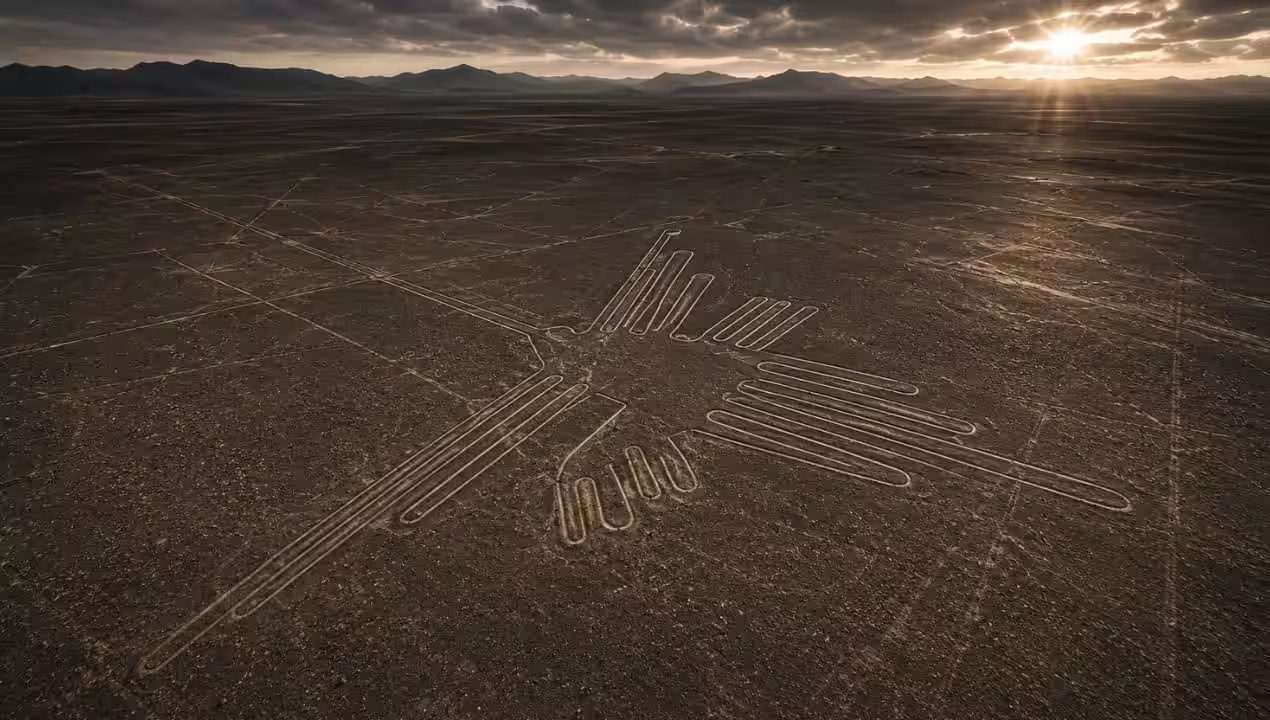
The Nazca Lines
By ABYSSGENERATED
Published: 2026-06-30
Updated: 2026-06-30
Discover the mysterious Nazca Lines, enormous geoglyphs etched into the Peruvian desert whose origin, purpose, and meaning continue to fascinate researchers.
The Nazca Lines: One of the World's Greatest Archaeological Mysteries
Deep within the arid desert of southern Peru lies one of the most fascinating archaeological sites on Earth: the Nazca Lines. Spread across the vast Nazca Desert, hundreds of enormous geoglyphs cover the landscape. Some depict animals such as hummingbirds, monkeys, spiders, whales, and condors, while others form geometric patterns, spirals, trapezoids, and perfectly straight lines stretching for several kilometers. Visible mainly from the air, these gigantic drawings have fascinated scientists, historians, and travelers for decades. Who created them? Why were they made? And how could an ancient civilization produce such precise designs without the ability to view them from above? Although archaeological research has answered many questions, several aspects of the Nazca Lines remain open to interpretation. Combining historical evidence, scientific investigation, and enduring mystery, they continue to rank among humanity's greatest archaeological enigmas.
The Nazca Civilization
The Nazca Lines were created by the Nazca civilization, which flourished along Peru's southern coast between approximately 200 BC and AD 600. Living in one of the driest deserts in the world, the Nazca developed an advanced society capable of thriving in harsh environmental conditions. They built sophisticated underground aqueducts known as puquios, allowing water to reach agricultural fields despite the lack of rainfall. The Nazca are also renowned for their colorful pottery, elaborate textiles, and ceremonial architecture, particularly at the sacred center of Cahuachi. Today, archaeologists believe the geoglyphs formed an important part of the Nazca's religious and ceremonial traditions.
The Discovery of the Nazca Lines
Local inhabitants had known about some of the desert markings for centuries, but their true scale remained unknown until the twentieth century. During the 1920s, archaeologists studying the region noticed unusual straight lines crossing the desert floor. The rapid development of aviation soon revealed the site's extraordinary nature. Pilots flying over the desert discovered hundreds of enormous figures that could only be fully appreciated from the sky. This aerial perspective transformed the Nazca Desert into one of the world's most important archaeological research sites.
How Were the Nazca Lines Created?
Despite their impressive appearance, the Nazca Lines are remarkably simple in construction. Rather than carving deeply into the ground, the Nazca people removed the dark, iron-rich stones covering the desert surface, exposing the lighter-colored soil beneath. The contrast between these two layers created the enormous drawings. The desert's extremely dry climate has preserved the geoglyphs for nearly two thousand years. Rainfall is exceptionally rare, while strong winds are uncommon, preventing significant erosion. Experimental archaeology has demonstrated that the figures could have been created using basic tools such as wooden stakes, ropes, and careful geometric planning, without requiring advanced technology or aerial observation.
Monumental Works of Art
Researchers have identified more than 800 straight lines, around 300 geometric figures, and over 70 representations of animals, plants, and human-like figures. Some straight lines extend for more than ten kilometers. The famous Hummingbird measures nearly one hundred meters in length. The Condor stretches more than one hundred thirty meters across. The Monkey is instantly recognizable thanks to its spiral-shaped tail. The Spider displays remarkably accurate anatomical proportions. Other figures include a whale, a dog, a tree, hands, flowers, and the mysterious humanoid figure commonly known as "The Astronaut."
The Most Famous Figures
The Hummingbird
One of the best-known geoglyphs, the hummingbird is often associated with fertility, renewal, and divine symbolism in Andean cultures. Its remarkable symmetry continues to impress archaeologists today.
The Monkey
Distinguished by its curled spiral tail, the Monkey is among the most photographed figures in Nazca. Some researchers believe it may symbolize connections between the Nazca civilization and the Amazon rainforest.
The Spider
The Spider became particularly famous after biologists noticed that it closely resembles a specific local spider species. It may represent fertility, rainfall, or seasonal renewal.
The Condor
In ancient Andean belief, the condor served as a messenger between humans and the gods. Its enormous wingspan reflects its spiritual importance within pre-Columbian cultures.
The Astronaut
Perhaps the site's most controversial figure, the Astronaut depicts a large-eyed humanoid standing on a hillside. While alternative theories claim it represents an extraterrestrial visitor, archaeologists generally interpret it as a stylized religious or ceremonial figure.
Maria Reiche's Lifelong Research
No individual contributed more to the study of the Nazca Lines than German mathematician and archaeologist Maria Reiche. Beginning in the 1940s, she devoted more than forty years of her life to documenting, measuring, and protecting the geoglyphs. Often working alone beneath the desert sun, she carefully cleaned sections of the lines using little more than a broom, allowing previously hidden figures to become visible again. Her detailed maps became invaluable to future archaeological research. Maria Reiche also proposed that several geoglyphs functioned as an enormous astronomical calendar. Although modern research has challenged many aspects of this theory, her dedication played a crucial role in preserving the site.
Scientific Theories
Today, archaeologists generally agree that the Nazca Lines served ceremonial rather than practical purposes. One leading hypothesis suggests they formed ritual pathways used during religious processions. Another links the geoglyphs to water rituals. Since water was the region's most valuable resource, ceremonies asking the gods for rainfall may have taken place along the lines. Excavations have uncovered pottery fragments, offerings, and ceremonial remains near several geoglyphs, supporting their religious significance. Rather than serving a single purpose, the lines may have fulfilled multiple ceremonial functions over several centuries.
The Astronomical Hypothesis
For decades, many researchers believed the Nazca Lines functioned as a giant astronomical calendar. Maria Reiche observed that certain lines appeared to align with the rising or setting of the Sun during solstices, while others pointed toward bright stars. Modern statistical studies, however, suggest that because hundreds of lines exist, some alignments are likely coincidental. Although astronomy may have influenced certain geoglyphs, most archaeologists no longer consider it the primary explanation for the entire complex.
Alternative Theories
The Nazca Lines gained worldwide fame through alternative interpretations. In the late 1960s, Swiss author Erich von Däniken argued that the enormous straight lines were landing strips for extraterrestrial spacecraft. His books became international bestsellers and helped popularize the ancient astronaut hypothesis. However, archaeologists reject this explanation. The geoglyphs are only a few centimeters deep and could never support the weight of any aircraft. Other theories involve lost civilizations, advanced prehistoric technology, or forgotten knowledge. To date, none of these ideas has been supported by archaeological evidence.
Modern Discoveries
Recent technological advances have transformed Nazca research. High-resolution drones now survey remote areas with unprecedented precision. Artificial intelligence is helping researchers identify faint geoglyphs almost invisible to the human eye. These technologies have led to the discovery of hundreds of previously unknown figures, some dating back even earlier than the Nazca civilization and possibly created by the Paracas culture. Each new discovery expands our understanding of the region's ancient history.
A Fragile World Heritage Site
In 1994, the Nazca Lines were designated a UNESCO World Heritage Site. Despite this international recognition, they remain extremely fragile. Even a single vehicle crossing the desert can leave visible tracks that persist for decades. Urban development, illegal construction, tourism, and climate-related events all pose threats to the preservation of the site. Peruvian authorities continue to implement monitoring and conservation programs to protect this irreplaceable cultural treasure.
The Nazca Lines in Popular Culture
The Nazca Lines have inspired countless documentaries, books, television programs, films, and video games. They frequently appear in productions exploring ancient mysteries, unexplained phenomena, and extraterrestrial theories. Their striking appearance has made them one of the world's most recognizable archaeological landmarks. While popular media has helped introduce millions of people to the Nazca Lines, it has also contributed to the spread of speculative theories lacking scientific support.
Why Does the Mystery Endure?
Modern archaeology has largely explained how the Nazca Lines were constructed and identified the civilization responsible for creating them. What remains uncertain is their precise meaning. Rather than serving one single purpose, the geoglyphs likely fulfilled several religious, ceremonial, and symbolic roles throughout the history of the Nazca civilization. This combination of established facts and unanswered questions continues to fuel both scientific research and public fascination.
Conclusion
The Nazca Lines stand among humanity's greatest archaeological achievements. Their immense scale, extraordinary preservation, and mysterious purpose make them one of the world's most remarkable ancient monuments. Although decades of research have greatly expanded our understanding of these geoglyphs, each new discovery reminds us that the Nazca Desert still holds many secrets waiting to be uncovered. Whether viewed as ceremonial pathways, sacred artwork, or expressions of an advanced ancient culture, the Nazca Lines remain a timeless symbol of human creativity and ingenuity. More than fifteen centuries after their creation, they continue to inspire archaeologists, historians, and curious minds around the globe, ensuring that their mystery will endure for generations to come.
Credits and origin
Origin of the Mystery
The Nazca Lines are among the world's greatest archaeological mysteries. Created between approximately 200 BC and AD 600 by the Nazca civilization, these enormous geoglyphs cover hundreds of square kilometers across the Peruvian desert. Their exceptional preservation is largely due to the region's extremely dry climate, which has protected the drawings for nearly two thousand years.
Although some of the markings had long been known locally, the full extent of the geoglyphs was only revealed with the development of aviation during the twentieth century. Since then, the Nazca Lines have become one of the most intensively studied archaeological sites in South America. While researchers now understand how they were created, their exact purpose remains the subject of ongoing debate. The leading scientific theories suggest ceremonial pathways, religious rituals, or water-related ceremonies, while more controversial ideas link them to lost civilizations or extraterrestrial visitors.
Today, the Nazca Lines are recognized as a UNESCO World Heritage Site and remain one of the most iconic symbols of pre-Columbian civilization, continuing to fascinate archaeologists, historians, and millions of visitors around the world.
Main Inspirations
- The Nazca civilization
- The Nazca Desert geoglyphs
- Maria Reiche's research
- Peruvian archaeological excavations
- Drone and artificial intelligence discoveries
- Ancient Andean religious traditions
- Astronomical theories about the geoglyphs
- Alternative theories popularized during the twentieth century
Key Facts
- Official Name: The Nazca Lines
- Location: Nazca Desert, Ica Region, Peru
- Creation Period: Approximately 200 BC – AD 600
- Civilization: Nazca (with some older geoglyphs attributed to the Paracas culture)
- Type: Monumental geoglyphs
- UNESCO Status: World Heritage Site (1994)
- Estimated Number: More than 800 straight lines, 300 geometric figures, and over 70 animal and human representations
- Dimensions: Some lines extend for more than 10 kilometers (6 miles)
- Construction Technique: Removal of the dark surface stones to expose the lighter-colored soil beneath
- Notable Features: Giant figures primarily visible from the air and exceptionally preserved by the desert climate
- Popularized Through: Books, documentaries, scientific research, ancient astronaut theories, and popular culture
FAQ
Who created the Nazca Lines?
The Nazca Lines were created by the Nazca civilization between approximately 200 BC and AD 600. Some older geoglyphs may have been produced earlier by the Paracas culture.
Why were the Nazca Lines created?
Their exact purpose remains unknown. Most archaeologists believe they were connected to religious ceremonies, ritual processions, or water-related beliefs that were essential in the desert environment.
How were the geoglyphs made?
The Nazca people removed the dark surface stones to expose the lighter-colored soil beneath. This simple technique, combined with the region's extremely dry climate, has preserved the drawings for nearly two thousand years.
Can the Nazca Lines be seen from the ground?
Some figures can be viewed from nearby hills or observation towers, but most of the geoglyphs can only be fully appreciated from the air or through aerial imagery.
Are the Nazca Lines connected to extraterrestrials?
There is no scientific evidence supporting this idea. Ancient astronaut theories became popular during the twentieth century, but archaeological research clearly attributes the geoglyphs to the Nazca civilization.
Why are the Nazca Lines so well preserved?
The Nazca Desert is one of the driest places on Earth. Minimal rainfall, almost no vegetation, and limited wind erosion have allowed the geoglyphs to survive for nearly two thousand years.