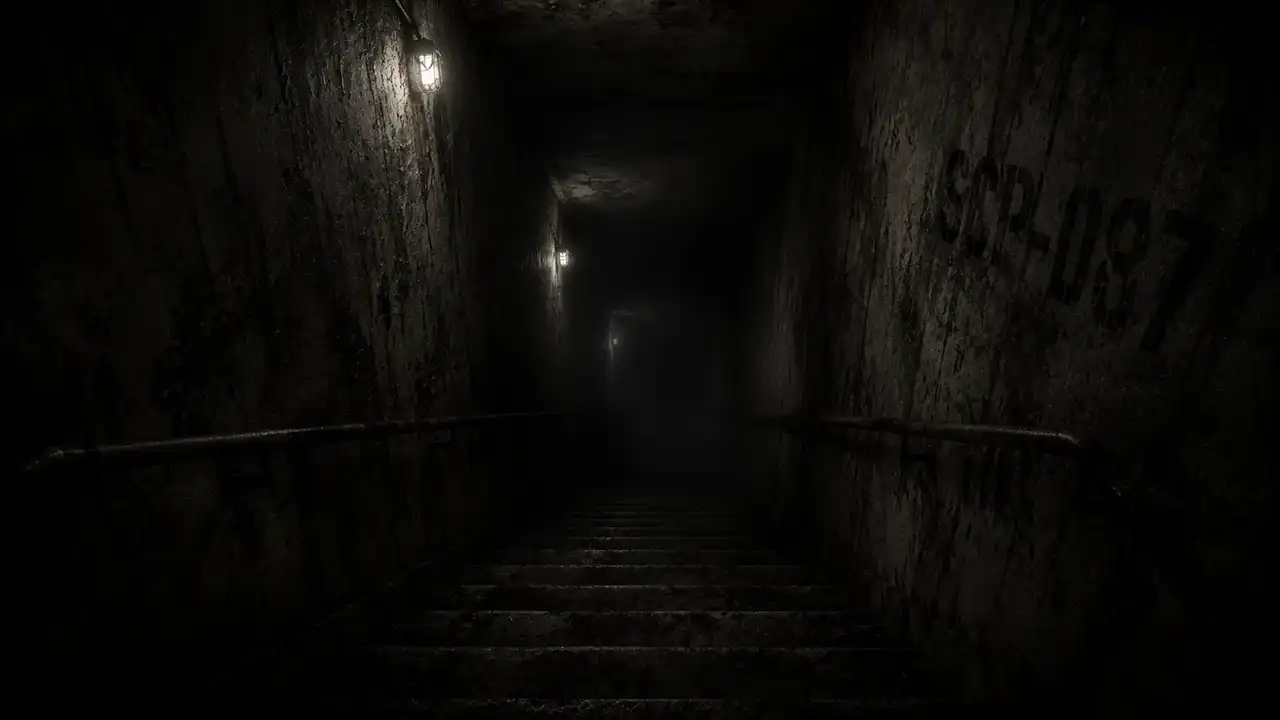
SCP-087 : The Stairwell
By ABYSSGENERATED
Published: 2026-06-10
Updated: 2026-07-04
Discover SCP-087, an apparently endless staircase shrouded in darkness, haunted by a mysterious humanoid entity linked to numerous disappearances.
An Unparalleled Architectural Anomaly
Among the countless architectural anomalies documented over the years, only a handful possess the ability to challenge the very foundations of modern physics. While some impossible locations are known for defying gravity, manipulating time, or distorting space in dramatic ways, this mysterious staircase is remarkable for the exact opposite reason: its overwhelming simplicity. Hidden behind an ordinary metal door indistinguishable from those found in countless industrial and administrative buildings lies a structure that appears, at first glance, to be nothing more than a neglected service stairwell. The concrete walls are worn by age, a plain steel handrail follows each flight of stairs, and the entrance itself gives no indication that anything unusual exists beyond it. Yet within only a few minutes of descending, visitors begin to realize that the environment no longer obeys any recognizable architectural logic. Every landing leads seamlessly to another identical flight of steps, creating the unsettling impression that the staircase extends far beyond the physical dimensions of the building that contains it. Unlike many anomalous locations that immediately overwhelm visitors with spectacular phenomena, this structure reveals its impossible nature gradually. The first signs are subtle enough to be dismissed as simple discomfort. The air feels slightly colder than expected, surrounding sounds become strangely muffled, and an overwhelming sensation of isolation slowly replaces the certainty that the outside world still exists just beyond the entrance. The deeper one descends, the stronger this feeling becomes. Rather than confronting explorers with obvious supernatural events, the staircase quietly erodes their confidence in the reliability of their own senses. This gradual transformation is precisely what makes the anomaly so disturbing. It never announces itself. Instead, it patiently allows reality itself to become increasingly questionable with every step.
Discovery of the Anomaly
The earliest reports concerning the staircase originated from maintenance workers employed inside an aging university complex. Several members of the staff independently described unusual experiences while using a rarely accessed service staircase located in one of the oldest sections of the building. Some claimed that the descent lasted far longer than it should have, despite the building possessing only a limited number of floors. Others reported hearing distant footsteps or metallic noises coming from levels that did not appear on any architectural blueprint. Initially, these accounts attracted little attention. Investigators assumed they resulted from fatigue, stress, or simple confusion caused by working in an isolated environment. Structural engineers thoroughly inspected the staircase, comparing its dimensions with the original construction plans and searching for hidden chambers or undocumented underground extensions. Every inspection reached the same conclusion. The staircase appeared completely ordinary. Its materials matched the rest of the building, no hidden passageways were discovered, and nothing suggested the existence of an abnormal structure beneath the foundations. Only after several controlled exploration missions did the first undeniable inconsistencies emerge. Teams equipped with precise measuring instruments discovered that the distance traveled quickly exceeded the maximum depth physically available beneath the building. According to every calculation, the explorers should have reached the bedrock long before completing even half of their recorded descent. Instead, the staircase continued exactly as before. Every landing opened onto another identical flight of stairs, each one indistinguishable from the last, as though the structure existed independently from the physical space surrounding it.
An Architecture Defined by Simplicity
Perhaps the most unsettling aspect of this anomaly is its complete lack of remarkable architectural features. Researchers spent years searching for hidden symbols, unusual construction techniques, or structural irregularities that might explain its impossible properties. They found nothing. Every visible component appears perfectly ordinary. The concrete steps display natural wear consistent with decades of use, the walls contain small cracks typical of aging buildings, and the steel handrails show signs of corrosion expected in an old staircase. Ironically, this overwhelming normality only amplifies the unsettling atmosphere. Unlike ancient temples, abandoned laboratories, or mysterious underground complexes, this location never attempts to impress its visitors. It resembles the countless forgotten stairwells hidden inside office buildings, schools, hospitals, or industrial facilities across the world. Its ordinary appearance makes the gradual realization of its impossible nature all the more disturbing. As explorers continue downward, many begin noticing an increasingly strange sense of repetition. Certain cracks in the walls appear oddly familiar. Water stains seem to reappear at regular intervals. Some investigators have even claimed to recognize specific imperfections in the concrete dozens of levels apart. Whether these similarities result from genuine architectural repetition or from subtle distortions affecting human perception remains unknown. Nevertheless, nearly every expedition reports the same growing difficulty in distinguishing one section of the staircase from another. This absence of recognizable landmarks gradually destroys the explorers' ability to judge their own progress. Without meaningful visual references, every landing begins to resemble the previous one, creating the disturbing impression that movement itself may have become meaningless. Some participants later described the sensation as walking through the same location repeatedly despite knowing that they had continued descending for hours.
A Depth Beyond Physical Reality
One of the primary objectives of the earliest scientific expeditions was to determine the true depth of the structure. Researchers employed laser rangefinders, inertial navigation systems, three-dimensional mapping equipment, and multiple independent measuring techniques in an attempt to produce an accurate survey of the staircase. The results rapidly exceeded every expectation. After only a relatively small number of landings, the recorded depth had already surpassed the known foundations of the building. Continued exploration suggested that the teams should have reached geological layers located hundreds of meters beneath the surface. According to conventional physics, they should eventually have encountered significant increases in pressure, noticeable temperature variations, or fundamental changes in the surrounding rock formations. None of these changes occurred.The walls remained identical.The temperature stayed remarkably stable.Air quality showed almost no variation.The staircase simply continued downward as though physical depth had ceased to possess any real meaning. This contradiction remains the central mystery surrounding the anomaly. Every improvement in measurement technology has only reinforced the conclusion that the staircase cannot be explained by ordinary geometry. Rather than existing as an unusually deep underground structure, it appears to create an interior space whose dimensions no longer correspond to the volume occupied by the building itself.
A Darkness That Appears to Consume Light
One of the most extensively studied aspects of the anomaly is the unusual behavior of light inside the staircase. Every expedition, regardless of its objective or the equipment involved, has reported the same phenomenon. Illumination devices operate normally before entering the structure, but their effective range decreases dramatically once the descent begins. High-powered industrial floodlights, military-grade flashlights, and specialized exploration equipment all produce nearly identical results. Beyond a surprisingly short distance, the beam simply disappears into an almost impenetrable darkness. The phenomenon cannot be explained by ordinary environmental conditions. The air contains no measurable concentration of dust, smoke, or suspended particles capable of scattering light to such an extent. Thermal imaging systems, infrared cameras, and laser measuring devices have all demonstrated similarly inconsistent behavior, often providing contradictory readings despite operating under identical conditions. In several documented experiments, two identical instruments placed side by side produced noticeably different measurements, suggesting that the anomaly may interact with observation itself rather than with the equipment alone. Many explorers describe the darkness as possessing an unusual psychological quality. Rather than feeling like the simple absence of light, it creates the unsettling impression of concealing an environment that actively resists being observed. Although no scientific evidence supports this interpretation, the remarkable consistency of these testimonies has led researchers to consider the possibility that the darkness represents an integral property of the anomaly rather than a consequence of inadequate illumination.
Unexplained Sensory Phenomena
As exploration missions became increasingly ambitious, investigators began documenting a wide range of sensory anomalies that extended far beyond the staircase's impossible geometry. The earliest reports focused primarily on sound. Footsteps occasionally produced echoes that returned several seconds later, while metallic noises seemed to originate from impossible directions. Some researchers heard faint impacts rising from the depths below, whereas others perceived identical sounds coming from levels they had already passed. These auditory irregularities gradually became more complex during longer expeditions. Several teams reported hearing distant conversations without being able to distinguish individual words. Others became convinced that someone was descending only a few landings behind them, matching their pace with remarkable precision. Whenever they stopped to investigate, however, the sounds vanished completely, leaving behind an almost oppressive silence that many participants described as far more disturbing than the noises themselves. Attempts to document these events produced equally puzzling results. Audio recorders occasionally captured sounds that none of the explorers remembered hearing, while many of the most detailed eyewitness accounts left no trace whatsoever on electronic recordings. This persistent inconsistency has prevented researchers from determining whether the anomaly generates objective acoustic events or whether it somehow alters human perception in ways that conventional recording equipment cannot detect. Visual observations are no less contradictory. Some participants report fleeting movements near the edge of their flashlight beams, describing vague silhouettes that disappear before they can be examined directly. Others insist they experienced no visual anomalies at all, despite sharing nearly identical routes with teammates who reported multiple unexplained observations. The inability to establish a consistent pattern has become one of the greatest obstacles to understanding the phenomenon.
Psychological Effects of Prolonged Exposure
Although no expedition has documented direct physical aggression associated with the staircase, prolonged exposure appears to produce significant psychological effects. These changes rarely occur suddenly. Instead, they develop gradually, often becoming noticeable only after explorers have spent considerable time within the structure. The earliest symptoms usually involve a growing difficulty estimating the passage of time. Individuals frequently underestimate or overestimate the duration of their descent by several hours, despite carrying synchronized clocks that continue functioning normally throughout the mission. Spatial awareness is affected in a similar manner. Participants often struggle to determine how many landings they have crossed or whether they have recently passed through a particular section of the staircase. The remarkable architectural uniformity undoubtedly contributes to this confusion, yet psychologists believe it cannot fully explain the severity of the reported disorientation. Several explorers have later admitted that they eventually stopped trying to count the levels altogether, feeling as though numerical measurements had become meaningless inside the anomaly. Perhaps the most remarkable psychological effect is the persistent sensation of being observed. This impression appears across an overwhelming number of expedition reports, regardless of the participants' experience, expectations, or cultural background. Most individuals are unable to explain why they felt watched, nor do they claim to have actually seen another presence. Nevertheless, they consistently describe the feeling as immediate, unmistakable, and impossible to ignore. Some compare it to entering a room where another person is silently standing just outside their field of vision, while others describe it as an instinctive certainty that they were no longer alone. Medical examinations performed after expeditions have identified no lasting neurological damage directly attributable to the anomaly. However, a number of participants reported recurring dreams involving endless staircases, unfamiliar corridors, or the overwhelming sensation of descending without ever approaching a destination. Although these symptoms usually diminish over time, they remain one of the most frequently documented aftereffects of extended exploration.
Scientific Theories
The staircase continues to challenge every conventional explanation proposed by the scientific community. One of the earliest theories suggested that the anomaly represents a localized distortion of space, allowing an interior volume vastly larger than the physical dimensions visible from outside. While this hypothesis successfully accounts for the impossible depth recorded during multiple expeditions, it fails to explain the unusual sensory phenomena and the remarkable consistency of the reported psychological effects. A second theory proposes that each landing functions as a nearly imperceptible transition between separate yet architecturally identical spaces. Under this model, explorers do not descend through a single continuous structure but instead move across a sequence of interconnected environments that collectively create the illusion of an endless staircase. Although this idea explains certain inconsistencies observed during mapping attempts, no measurable evidence has yet confirmed the existence of such transitions. Other researchers favor a more cognitive interpretation. According to this perspective, the anomaly may influence the neurological processes responsible for constructing human perception. Rather than physically extending forever, the staircase could interfere with the brain's ability to interpret distance, orientation, and time, causing explorers to experience an environment fundamentally different from objective reality. While attractive in theory, this explanation struggles to account for the numerous instrumental anomalies documented over decades of investigation. For now, every hypothesis remains incomplete. Each explains certain observations while leaving many others unresolved.
An Enduring Mystery
Despite remarkable advances in imaging technology, spatial modeling, environmental monitoring, and cognitive science, the staircase remains one of the least understood architectural anomalies ever documented. Every expedition contributes valuable information, yet each new discovery raises additional questions that challenge existing theories. The more researchers learn about the structure, the more apparent it becomes that conventional scientific models may simply be insufficient to describe it. Its enduring fascination lies precisely in this uncertainty. The anomaly does not rely on spectacular displays or obvious danger to inspire fear. Instead, it quietly undermines humanity's confidence in the stability of reality itself. An ordinary staircase, constructed from ordinary materials, becomes a place where familiar concepts such as distance, orientation, perception, and even time gradually lose their meaning. Whether the staircase possesses a true end remains unknown. It may eventually terminate at a level no expedition has yet reached. It may continue indefinitely through a space disconnected from ordinary geometry. Or perhaps its greatest mystery is not where it leads, but why it exists at all. Until those questions can be answered, the anomaly will remain one of the most compelling examples of how an apparently mundane structure can conceal a reality that defies every known law of the physical world.
Modern Research Efforts
As scientific understanding has evolved, so too have the methods used to investigate the staircase. Early expeditions relied almost entirely on direct observation, handwritten notes, and conventional measuring equipment. Modern research teams, however, approach the anomaly with far more sophisticated technology. Autonomous drones, high-resolution laser scanners, environmental monitoring systems, synchronized sensor arrays, and artificial intelligence-assisted mapping software have all been deployed in an effort to construct a complete model of the structure. Despite these technological advances, the anomaly continues to resist every attempt at comprehensive documentation. Three-dimensional scans frequently contain missing sections that cannot be explained by equipment failure. Navigation software occasionally generates maps in which corridors intersect impossible angles or where the calculated position of a landing changes between successive scans. Even when identical routes are repeated under controlled conditions, the resulting models rarely match perfectly. These discrepancies are often subtle, yet they occur with enough consistency to suggest that the environment cannot be described using conventional geometric principles. Researchers have increasingly shifted their focus away from finding the "bottom" of the staircase. Instead, many laboratories now concentrate on identifying patterns within the anomaly itself. They compare environmental data collected over multiple expeditions, searching for recurring cycles, measurable fluctuations, or correlations between the explorers' experiences and recorded sensor readings. While several intriguing statistical relationships have emerged, none have yet provided a definitive explanation for the staircase's impossible properties.
Could the Staircase Be Changing?
One of the most controversial theories surrounding the anomaly proposes that the staircase is not a static structure at all. Rather than existing as a fixed architectural space, it may slowly evolve over time. This hypothesis first emerged after investigators began comparing reports written years apart. Although the overall layout remained remarkably consistent, small details occasionally differed in unexpected ways. Hairline cracks described in early reports appeared to have disappeared during later expeditions. Sections of handrail previously documented as heavily corroded were found in surprisingly good condition. In a few rare cases, researchers described architectural features that subsequent teams were unable to locate despite carefully following the same route. None of these differences were dramatic enough to prove that the structure had physically changed, yet their cumulative effect raised questions that have never been satisfactorily answered. Skeptics argue that these inconsistencies result from the staircase's repetitive appearance, making minor observational errors inevitable. Supporters of the evolving-structure hypothesis counter that the number of discrepancies exceeds what would normally be expected from human error alone. If the staircase is indeed capable of altering itself, even gradually, then every expedition may be exploring a slightly different environment from those that came before.
The Human Factor
An equally important area of research concerns the role played by the observers themselves. The remarkable consistency of certain psychological effects suggests that human perception may be deeply intertwined with the anomaly's behavior. Nearly every participant describes a growing feeling of isolation, accompanied by the impression that the outside world becomes increasingly distant with every landing crossed. Interestingly, these sensations often begin long before any measurable anomalies appear on scientific instruments. Several psychologists have proposed that the staircase exploits fundamental mechanisms of human perception rather than directly violating physical law. According to this interpretation, the anomaly may amplify ordinary cognitive processes such as spatial memory, pattern recognition, and expectation until they begin producing experiences that feel objectively real. This could explain why two explorers occasionally report slightly different observations despite remaining together throughout an expedition. Other researchers reject this explanation, noting that numerous instrumental inconsistencies cannot easily be attributed to psychological influences alone. The continuing disagreement between these two schools of thought has become one of the defining characteristics of modern research surrounding the staircase. Rather than converging toward a single explanation, each new discovery appears to strengthen multiple competing interpretations simultaneously.
Why the Anomaly Continues to Fascinate
The staircase has become far more than an isolated scientific curiosity. It represents a powerful reminder that some of the greatest mysteries are hidden behind the most ordinary appearances. Unlike dramatic anomalies that immediately reveal their extraordinary nature, this structure offers no obvious warning. It resembles countless forgotten stairwells scattered throughout aging buildings across the world, making it strangely relatable despite its impossible properties. This contrast between familiarity and impossibility is perhaps the source of its enduring fascination. Every visitor begins their descent believing they understand the environment around them. Only gradually do they realize that each assumption about distance, orientation, and progression is becoming increasingly unreliable. The anomaly never forces this realization upon its observers. Instead, it patiently allows certainty to dissolve one step at a time. For scientists, the staircase represents one of the greatest unsolved challenges in the study of anomalous environments. For psychologists, it offers a unique opportunity to examine the relationship between perception and reality. For philosophers, it raises profound questions about whether space itself can exist independently of human understanding. Each discipline approaches the anomaly from a different perspective, yet none has succeeded in revealing its true nature.
An Unanswered Descent
After decades of investigation, the staircase remains as enigmatic as it was when it was first discovered. Thousands of measurements, countless hours of observation, and numerous technological breakthroughs have expanded humanity's understanding of the phenomenon without bringing it significantly closer to a complete explanation. Every expedition confirms that the anomaly is real, yet none has managed to determine where it ultimately leads or why it exists. Whether it represents a natural phenomenon beyond current scientific knowledge, an unknown form of spatial distortion, or something even more extraordinary remains impossible to determine. What is certain, however, is that the staircase continues to challenge one of humanity's deepest assumptions—that every journey must eventually reach an end. Until that final landing is found, if it exists at all, the anomaly will continue to stand as a symbol of the unknown: an ordinary staircase that quietly invites those willing to descend, while refusing to reveal what lies beyond the darkness below.
Credits and origin
This anomaly is widely regarded as one of the most influential creations within the SCP universe. Its lasting popularity comes from its psychological approach to horror, where uncertainty and imagination are often more frightening than direct confrontation. Rather than relying on visible threats, the story builds tension through isolation, endless descent, and the unsettling feeling that something always remains hidden beyond the reach of light. Over the years, it has become one of the defining examples of internet horror fiction. Its atmosphere has inspired countless writers, content creators, and independent game developers. Among the best-known adaptations is SCP-087-B, a game that introduced many players to the SCP universe long before they discovered the original wiki. The anomaly is also frequently cited as one of the finest examples of the "fear of the unknown," demonstrating how unanswered questions can create a stronger sense of dread than any definitive explanation. This approach has influenced numerous works centered around liminal spaces, impossible architecture, endless structures, and psychological horror.
Main inspirations:
• Liminal spaces and impossible architecture • The instinctive fear of great depths • Abandoned and silent locations • Psychological horror • Darkness and the loss of orientation • Infinite labyrinths and endless structures
Origin: SCP Foundation
Object Class: Euclid
Type: Anomalous location
Themes: Exploration, impossible space, fear of the unknown, psychological horror
Cultural impact: SCP Wiki, SCP-087-B, independent horror games, and countless community creations